• Login (enter your user name) and Password
    Please Login. You are NOT Logged in.

    Quick Search:

  • To see new sales and other StampAuctionNetwork® news in your Facebook newsfeed then Like us on Facebook!

Login to Use StampAuctionNetwork®.
New Member? Click "Register".

StampAuctionNetwork® Extended Features


More Useful Information:


You are not logged in. Please Login so that we can determine your registration status with this firm. If you have never registered, please register by pressing the [Quick Signup (New to StampAuctionNetwork)] button. Then Login. Listen to Live Audio!
 
 
Quick Navigation by Category 
Autographs (4)   |  Confederate Stamps and Postal History (271)   | 
 

logo

Confederate Stamps and Postal History continued...

Confederate Regular Issues & Stampless Period continued...
LotNo. Symbol CatNo. Lot Description
221 c   image(11) 10c blue Davis (Archer & Daly printing), two horizontal pairs, tied by bold four-bar cork grid cancels with matching “Canton, Miss. Aug 30, 1864” cds on cover addressed to Mrs. Theophilus Perry, care of Mr. Levin Perry, Marshall, Harrison Co., Texas. Manuscript routing endorsement “Via Brandon” at left. The four 10c stamps pay the 40c Trans-Mississippi Express Mail rate per half ounce. Stamps and cover edges affected by wear but considering the journey this cover undertook to arrive at its destination and age, it retains a fine appearance for a scarce westbound express usage. The Trans-Mississippi Express Mail service was authorized May 1, 1863, permitting expedited communication across the Mississippi River between the eastern Confederacy and the isolated Trans-Mississippi Department. Postmaster General John H. Reagan fixed the prepaid rate at 40¢ per half ounce — a substantial premium over ordinary letter postage. Following the fall of Vicksburg in July 1863, Union naval control of the river made crossings hazardous and irregular, and the express system relied on discreet relay routes and river crossings to evade Federal patrols. Surviving examples frequently bear routing endorsements such as “Via Brandon” or “Via Meridian” when originating east of the river, as seen here. Fewer than 200 Trans-Mississippi Express covers are recorded. While eastbound examples are more often encountered, westbound covers - such as this Mississippi-to-Texas usage - are considerably scarcer and especially desirable. The bold four-bar cork cancels and clear Canton cds are characteristic of properly prepaid express mail originating east of the river. The addressee, Mrs. Harriet Eliza Perry, was the wife of Capt. Theophilus Perry of Company F, 28th Texas Cavalry (Walker’s Texas Division). The regiment campaigned extensively in Arkansas and Louisiana as part of the Trans-Mississippi Department. Their correspondence was later published by the University of Arkansas Press under the title Widows by the Thousand. A highly desirable westbound Trans-Mississippi Express Mail cover, combining correct 40¢ prepaid rate, routing endorsement, and well-struck Canton markings - a fine example of this scarce and dramatic Confederate wartime service. (Image)

Get Market Data for [United States (Confederate States) 11] View Visual Pricing Guide Make Sample Census


Current Opening Price...$1,000.00
Will close during Public Auction
222 c   image(11a) 1863 10c milky blue Davis tied by neat black “Dublin, Va.” cds with unclear month/day date on brown cover addressed to Hon. Thomas S. Gholson, Petersburg, Va. The stamp is additionally tying by manuscript signature of “C. S. Stringfellow,” Assistant Adjutant General, Army of Northern Virginia, very fine. This cover represents correspondence between two prominent Confederate figures at an early stage of the war. The sender, Charles S. Stringfellow, served as Assistant Adjutant General with the Army of Northern Virginia and held the rank of major. He was actively engaged in the Confederate campaign into western Virginia during 1861, a critical and fluid theater as the Confederacy attempted -ultimately unsuccessfully - to retain control of the region that would soon become West Virginia. Stringfellow’s manuscript endorsement underscores the military origin of the correspondence and reflects common wartime practice among Confederate officers. The addressee, Judge Thomas Saunders Gholson (1808–1868), was a distinguished jurist, railroad executive, and political leader. Born in Brunswick County, Virginia, Gholson became a judge of the Virginia state circuit court in 1859 and was deeply involved in the region’s legal and economic development. He later served as president of several railroads - an especially vital role during the war, when rail infrastructure underpinned Confederate logistics - and was elected to the Confederate Congress, where he represented Virginia’s interests until the end of the conflict. Gholson’s extensive public service before, during, and after the war places him firmly among the Confederacy’s civilian leadership. Covers directly linking Confederate military staff officers with senior political and judicial figures are especially desirable, offering a tangible connection between battlefield administration and the civilian governance of the Confederate States. Ex Whittle, initialed by Patricia A. Kaufmann. (Image)

Get Market Data for [United States (Confederate States) 11a] View Visual Pricing Guide Make Sample Census


Current Opening Price...$300.00
Will close during Public Auction
223 c   image(11c) 10c greenish blue Davis tied by “Charleston S.C. Jan 14” (possibly 1865) cds on small cover addressed to “Miss Minnie Mordecai, Hon. M.C. Mordecai, Columbia, S.C.,” Mordecai was a prominent Charleston merchant and one of the leading Jewish citizens of the city. The sender is believed to be Edgar Michael Lazarus (1838–1884), who himself belonged to a prominent South Carolina Jewish family and was newly married to the addressee at the time this letter was sent. He was serving in Manigault’s South Carolina Light Artillery Battalion, part of the Charleston Harbor siege train responsible for the city’s coastal defenses. Owing to the increasing threat to Charleston from Union artillery, the Mordecai family temporarily relocated to Columbia in late 1864, explaining the inland destination and reflecting the broader civilian displacement caused by the war. The cover thus forms part of the intimate wartime correspondence between Edgar and Minnie, linking two influential Jewish families whose members were deeply embedded in the civic, commercial, and military life of Confederate South Carolina, very fine. Initialed by Patricia Kaufmann. (Image)

Get Market Data for [United States (Confederate States) 11c] View Visual Pricing Guide Make Sample Census


Current Opening Price...$300.00
Will close during Public Auction
224 c   image(12e) 1863-64 10c green Davis tied by black “Richmond, Va. Dec. 5, 1863” cds on cover sent to Petersburg, Virginia. A particularly attractive example of the 10¢ Davis green color variety on Confederate mail during the mature phase of the Richmond postal system. Horizontal file fold well clear of stamp, overall fine and attractive. Ex Parks & Powell, initialed by Patricia A. Kaufmann. (Image)

Get Market Data for [United States (Confederate States) 12e] View Visual Pricing Guide Make Sample Census


Current Opening Price...$100.00
Will close during Public Auction
225 c   image(12) Turned cover showing two distinct 1863-64 10c Davis printings in separate wartime uses. The first use bears 1863 10c Davis (Archer & Daly printing) with pen-canceled and manuscript “Chula Depot, Va. Jan 25,” addressed to Miss Lizzie C. Waller, care of Capt. L. T. Waller, Farmville, Virginia. Cover then turned inside out for second use with 1864 10c Davis (Keatinge & Ball printing) tied by a Farmville, Va. cds (date indistinct but clearly early 1865), addressed to Mrs. Mary Maxwell, care of Mrs. P. E. Carrington, Providence P.O., Halifax Co., Virginia. The second stamp is clearly a Keatinge & Ball printing, placing the reuse in the final months of the Confederacy. The cover illustrates typical paper economy of the late war period, with backflap missing and the upper left corner cut and refolded to expose the first-use stamp for display. The addressee of the second use, Mary Maxwell, was likely the widow of William Maxwell, a prominent pre-war Virginia political figure. At the time of the second use she was residing with Mrs. William S. Carrington (née Sarah Embra Carrington) at “Mildendo,” the Carrington plantation in Halifax County. Mildendo functioned as a wartime refuge for extended family and associates during the closing campaigns around Richmond and Petersburg, lending additional historical resonance to this late-war turned usage. Condition typical for a turned-use Confederate cover, with faults as noted, but a scarce and appealing dual-printing turned cover combining Archer & Daly and Keatinge & Ball 10c issues in early 1865. (Image)

Get Market Data for [United States (Confederate States) 12] View Visual Pricing Guide Make Sample Census


Current Opening Price...$200.00
Will close during Public Auction
226 c   image(12) 1864 10c blue Davis, Die B (Keatinge & Ball), a vertical pair tied by “Danville Va. Mar 17” (1865) cds on homemade cover addressed to Mrs. Mary Maxwell, Care of Mrs. W. S. Carrington, Providence, Halifax Co., Va. A fine and scarce late-war 20c franking paid by a 10c Keatinge & Ball Die B pair. This cover was mailed only three weeks before the fall of Richmond and a mere eight days before Lee’s retreat from Petersburg began on April 25, 1865. The Keatinge & Ball Die B printings did not become available until September 1864, making this early-1865 usage from Danville - soon to serve briefly as the final Confederate capital - particularly significant. The addressee, Mary Maxwell, was likely the widow of William Maxwell, a well-known pre-war Virginia political figure. She was staying with Mrs. William S. Carrington, née Sarah Embra Carrington, at “Mildendo,” the Carrington plantation in Halifax County. Mildendo served as a wartime refuge for extended family and associates during the final campaigns around Richmond and Petersburg. A choice example of a late Confederate postal usage of a 10c Die B pair, demonstrating the necessity of higher franking for overweight correspondence and the disrupted civilian mail patterns of March 1865 as the Confederacy neared collapse. Ex Dietz. (Image)

Get Market Data for [United States (Confederate States) 12] View Visual Pricing Guide Make Sample Census


Current Opening Price...$300.00
Will close during Public Auction
227 c   image(12) 10c blue Jefferson Davis, Keatinge & Ball printing, used on cover by Charleston, South Carolina cds, addressed to Mrs. Edgar M. Lazarus, Columbia, South Carolina, representing a late-war Confederate domestic usage during the evacuation pressures on Charleston. The sender, Edgar Michael Lazarus (1838–1884), a member of a prominent South Carolina Jewish family, was serving in Manigault’s South Carolina Light Artillery Battalion as part of the Charleston Harbor defenses, while the addressee, his wife Minnie (née Mordecai), had relocated inland to Columbia amid increasing Union threat to the city. This correspondence reflects both the strategic conditions in Charleston during the final year of the war and the civilian displacement experienced by families connected to Confederate military operations, overall in very fine condition. Signed by John L. Kimbrough (1-15-1994). (Image)

Get Market Data for [United States (Confederate States) 12] View Visual Pricing Guide Make Sample Census


Current Opening Price...$300.00
Will close during Public Auction
228 c   image(12c) 1863 10c greenish blue Jefferson Davis tied by clear “Richmond, Va., Feb 4” cds on black-bordered mourning cover addressed to Lt. Col. R. L. Maury, 24th Virginia Infantry, Kemper’s Brigade, Pickett’s Division. The 10c franking represents an overpayment of the 2c local (drop-letter) rate within Richmond, a noteworthy but not uncommon characteristic of late-war correspondence. The complete military designation - regiment, brigade, and division - is a particularly desirable feature on Confederate officer correspondence, very fine. Richard Lancelot Maury (1840–1907) was the son of the famed U.S. Navy oceanographer and naval officer Commodore Matthew Fontaine Maury. He entered military service in 1861 as a Private in the Virginia Militia, soon becoming a Lieutenant upon entry into the Virginia Provisional Army. Promoted to Major by late 1861, Maury saw heavy combat at Williamsburg in May 1862 and was badly wounded in the arm at Seven Pines (Fair Oaks) later that year. Advanced to Lieutenant Colonel in April 1863, he later sustained a severe hip wound following the Second Battle of Drewry’s Bluff in 1864. By early 1865, his active field service had effectively ceased. Kemper’s Brigade, composed of the 1st, 3rd, 7th, 11th, and 24th Virginia Infantry Regiments, was among the most heavily engaged formations of the Army of Northern Virginia during this period. After catastrophic losses during Pickett’s Charge at Gettysburg - where Brig. Gen. James L. Kemper was wounded and captured - the brigade was rebuilt and fought continuously through the Overland Campaign, Cold Harbor, and the prolonged Richmond-Petersburg siege, remaining on the lines until the final collapse in April 1865. Based on an initial census of the Maury correspondence prepared by Paul Bearer, this cover is believed to represent the final known wartime cover sent to Lt. Col. Maury during the Civil War, written only weeks before the fall of Richmond and Petersburg. A very fine and historically significant Confederate mourning cover, combining precise military attribution, late-war postal usage, and compelling personal context from one of the Army of Northern Virginia’s most heavily tested brigades. Initialed by Patricia A. Kaufmann & James Taff. (Image)

Get Market Data for [United States (Confederate States) 12c] View Visual Pricing Guide Make Sample Census


Current Opening Price...$500.00
Will close during Public Auction
229 c   image(12f) 1863 10c blue Davis, officially perforated 12½, tied by bold “Columbus, Ga. / Dec 2” (1864) cds on cover addressed to Lieut. L. R. Ray, Acting Ordnance Officer, Macon Arsenal, care of Col. R. W. Cuyler, Commandant. Stamp with full original perforations typical of this short-lived experimental period, cover reduced at left with wear at edges and file fold slightly affecting stamp. The original letter accompanies the cover. Its text was preserved and published by Rick Norton in The Confederate Philatelist (Jan–Feb 1998), where this cover appeared as Figure 2 in his study of Georgia’s officially perforated Archer & Daly stamps. The letter - written by Dennis Beckmith, a Georgia State Guard soldier temporarily stationed in Columbus - provides vivid commentary on military conditions, supply shortages, and rumors circulating during Sherman’s March to the Sea. Beckmith was writing to his cousin, Lieutenant Lavender R. Ray, then serving as Acting Ordnance Officer at the Macon Arsenal. Ray’s position made him a direct participant in Macon’s critical military production system under Col. Richard W. Cuyler, responsible for supplying arms and artillery to Western Theater armies in the war’s closing phase. The use of the official perforation (Perf 12½) strongly supports Norton’s observation that these stamps were distributed primarily to military depots and arsenals in Georgia during late 1864-early 1865, when wartime manpower shortages and increased mail volume made perforation desirable despite limited equipment. A highly desirable General Issue major variety used on cover, combining the Columbus cds, a scarce experimental perforated 1863 10c, and a historically rich wartime letter. (Image)

Get Market Data for [United States (Confederate States) 12f] View Visual Pricing Guide Make Sample Census


Current Opening Price...$400.00
Will close during Public Auction
230 O   image(13) 20c green Washington, used with full to large margins all around, very fine, with 2008 APS certificate, cat. value $400. (Image)

Get Market Data for [United States (Confederate States) 13] View Visual Pricing Guide Make Sample Census


Current Opening Price...$150.00
Will close during Public Auction
231 c   image(13) 1863 20c green Washington, tied by manuscript “Loving Creek Va. July 20” (1863 or 1864) on cover addressed to Mrs. Dr. C. C. Cocke, “Bremo,” Bremo Bluff P.O., Fluvanna Co., Va. A fine and appealing high-denomination usage to one of Virginia’s most historic plantation homes. The addressee, Lucy W. Cocke, was the wife of Dr. Cary C. Cocke, owner of Bremo, an architecturally significant plantation overlooking the James River. Designed in part by Thomas Jefferson, Bremo served as a social and logistical hub in central Virginia during the war. Members of Robert E. Lee’s family including Lee's wife stayed at Bremo for extended periods during and after the conflict, and Lee himself visited there on multiple occasions in the post-war years. Dr. Cocke helped raise an artillery unit for Confederate service—the Fluvanna Light Artillery—in 1861 and served as its commanding officer until that company merged into another Fluvanna unit in 1862 to form the Fluvanna Consolidated Artillery. His wartime duties and local prominence made Bremo a frequent destination for military and civilian correspondence. A desirable 20c high-value franking, used during a period when such stamps primarily saw service on overweight letters or long-distance mail. High-denomination covers from small Virginia post offices are notably scarce and add significant depth to any study of Confederate postal operations. Ex Bleuler, with 1985 Philatelic Foundation certificate, cat. value $1,250. (Image)

Get Market Data for [United States (Confederate States) 13] View Visual Pricing Guide Make Sample Census


Current Opening Price...$500.00
Will close during Public Auction
232 c   image(13) 1863 20c green Washington, horizontal pair, tied by “Waco Village Texas” cds on cover addressed to Virginia, paying the 40c Trans-Mississippi Express rate. Cover with heavy staining, wrinkles, corner creases and missing backflap, as typical for this class of usage. A rare and important Trans-Mississippi usage carried after the fall of Vicksburg and the effective closure of the Mississippi River, when special express routes were established to move mail between the western Confederacy and the eastern states. The 40c rate, paid here by a pair of 20c stamps, reflects this extraordinary and short-lived postal arrangement under the Confederate Trans-Mississippi Department. Ex Dabney, cat. value $4,500. (Image)

Get Market Data for [United States (Confederate States) 13] View Visual Pricing Guide Make Sample Census


Current Opening Price...$400.00
Will close during Public Auction
233 c   image(13) 1863 20c green Washington, three ample margins, just in at top, tied by “Fayetteville N.C. Jul 24” cds on legal size cover addressed to Sheriff of Rowan County, Salisbury, N.C., showing scattered toned specks. An attractive single-franking usage on official correspondence, overall fine, ex Dabney, cat. value $1,250. (Image)

Get Market Data for [United States (Confederate States) 13] View Visual Pricing Guide Make Sample Census


Current Opening Price...$300.00
Will close during Public Auction
234   image(13) 1863 20c green Washington used by black target cancel on cover addressed to Sheriff Joseph Stead of Randolph County, North Carolina, endorsed "Official" at left, ms "3 Reg SC Troop 14 April 1864" alongside, some cover faults in addition to the stamp being cut in, otherwise fine, cat. $1,250. (Image)

Get Market Data for [United States (Confederate States) 13] View Visual Pricing Guide Make Sample Census


Current Opening Price...$200.00
Will close during Public Auction
235 c   imagePair of lovely Confederate adversity covers nicely mounted on exhibit page featuring a turned cover and a wallpaper cover. The first is a remarkable turned cover originally sent from Columbia, South Carolina to Laurens Court House bearing a 10c blue (Archer & Daly) tied by "Columbia, S.C. September 7" (1863 or 1864) cds, on a single-letter rate cover. The recipient subsequently opened, reversed, and re-used the same envelope, mailing it back to Columbia with an 1863 20c green Washington stamp either paying the double-weight rate or a convenience overpayment due to potential lack of available 10c stamps. The 20c stamp is tied by Laurens Court House cds, demonstrating the Confederate practice of recycling envelopes during severe wartime shortages. Covers bearing the 20c green are particularly desirable, as the denomination also saw heavy use as small-change substitute currency during periods of coin scarcity. The second cover is an attractive stampless wallpaper cover from Morgan, Georgia to Hon. William E. Smith at Albany, Georgia, with “PAID 10” and "Morgan Ga, Oct 15" (1864) cds. Constructed from red-and-gray figured wallpaper - clearly visible with the flap opened for display - the cover exemplifies another form of Confederate resourcefulness in the face of blockade-induced shortages of commercial envelopes. The handstamped “PAID 10” indicates payment of the 10c single-letter rate at a time when adhesive supplies were not available at the post office. The recipient, William Ephraim Smith (1829–1890), served as a Representative to the Second Confederate Congress from Georgia (1864–65). Earlier in the war he served with the 4th Georgia Volunteer Infantry, initially enlisting as a 1st Lieutenant in April 1861 and later elected Captain of Company E (“Albany Guards”), which he commanded at Fredericksburg and Gettysburg. Following his election in November 1863, he left field service to take his seat when Congress convened in May 1864. The Second Confederate Congress was in recess during October 1864, explaining his presence at home in Albany at the time this cover was mailed and thereby helping confirm the year of use. Both covers show typical light wear consistent with adversity usages, but remain fine and highly presentable. A compelling and educational pair illustrating two classic forms of Confederate ingenuity - re-used (“turned”) envelopes and wallpaper-constructed covers. (Image)


Current Opening Price...$500.00
Will close during Public Auction
236 c   imageHuntsville, Alabama “PAID 5” handstamp on Confederate patriotic cover bearing a 7-Star Flag design, with matching blue double-ring "Huntsville, Ala Jul 1, 1861" cds at right sent to Augusta, Georgia. "Jas. L. Gow, Printer, Augusta, Ga. Patent applied for." imprint at bottom. Backflap added and some light restoration on front apparent, though still fine appearing. This early-war patriotic was mailed during Huntsville’s brief but intense surge of Confederate enthusiasm following Lincoln’s April 1861 call for 75,000 troops. With no Confederate adhesives yet available in northern Alabama, the Huntsville post office employed its distinctive blue double-ring datestamp and “PAID 5” rate marking to denote prepaid postage under the newly established Confederate postal system. Huntsville served as an important Confederate transportation hub in 1861 due to the Memphis & Charleston Railroad - one of the few east-west rail links spanning the Confederacy. This connection was severed when Union troops occupied Huntsville in April 1862, withdrew, and returned a year later to remain through the end of the war. Ex Oswald. (Image)


Current Opening Price...$500.00
Will close during Public Auction
237 c   imageWarrington, Florida use of matching “PAID” and “5" in circle rate handstamps on a stampless cover featuring Draper's Company Tent and 11-Star Confederate Flag patriotic design, printed in red and blue with military unit designation “Capt. Draper’s Company. 7th Reg. Alabama Vol.” below, addressed to J. A. Dickenson, Fife P.O., Talladega County, Alabama. “Warrington, Fla. Oct 8” (1861) cds at center Light age speckling and toned spots typical use, still fine appearing. Posted from the Confederate post office at Warrington - adjacent to Fort Barrancas on Pensacola Bay - this cover was mailed one day before the Battle of Santa Rosa Island (October 9, 1861), in which companies of the 7th Alabama Regiment, including Draper’s Company (“Calhoun Greys”), participated in the unsuccessful attempt to take Fort Pickens. The printed unit designation on the envelope ties this example directly to that early-war Gulf Coast activity. The addressee, J. A. Dickenson, corresponds to one of three men of that name on the Company B (“Draper’s Company”) muster roll of the 7th Alabama Regiment, almost certainly the writer is the youngest on the role, 18-year-old Private Elisha B. Dickenson, believed to have been home on furlough earlier that summer and likely the recipient’s son. The destination, Fife Post Office in Talladega County, lay only a few miles from where Draper’s Company was originally recruited. Signed by John L. Kimbrough (3-25-2008). (Image)


Current Opening Price...$500.00
Will close during Public Auction
238 c   imageBig Shanty, Georgia manuscript postmark “Big Shanty / Sept 29” (1861) alongside matching manuscript “Paid" (5) rate marking on red and blue 11-Star “Flag-Over-Tent” design confederate stampless cover, addressed to Miss N. C. Groves, Ducktown, Tennessee. Edge wear and light toning typical of period, still fine appearing. A classic early-war manuscript usage from Big Shanty (now Kennesaw), mailed during the period when Postmaster Lemuel Kendrick - despite presiding over one of Georgia’s largest military training camps -declined to procure official handstamps, instead writing all postal markings by hand. The year-date is firmly established by the original enclosure, a two-page Camp McDonald letter dated September 29, 1861, which remains with the cover. The writer, Lt. Robert N. Groves of Company B, 23rd Georgia Infantry, had been mustered into Confederate service just four weeks earlier, on August 31, 1861, and was undergoing training at Camp McDonald. He was writing to his sister Miss N. C. Groves in Ducktown, Tennessee - a divided region where both Unionist and Confederate companies were raised. Lt. Groves would later be promoted to captain in 1862 and survive the war. Big Shanty would become famous the following spring as the starting point of the “Great Locomotive Chase” on the Western & Atlantic Railroad, but this September 1861 cover predates that event and represents the camp’s intense early-war activity. A desirable Georgia Confederate patriotic usage combining a manuscript postmark, battlefield-bound soldier correspondence, and a vivid 11-Star flag design - an excellent example of Big Shanty’s distinctive stampless postal practice. Signed by John L. Kimbrough (12-17-2004). (Image)

Get Market Data for [United States (Confederate States) 1861] View Visual Pricing Guide Make Sample Census


Current Opening Price...$300.00
Will close during Public Auction
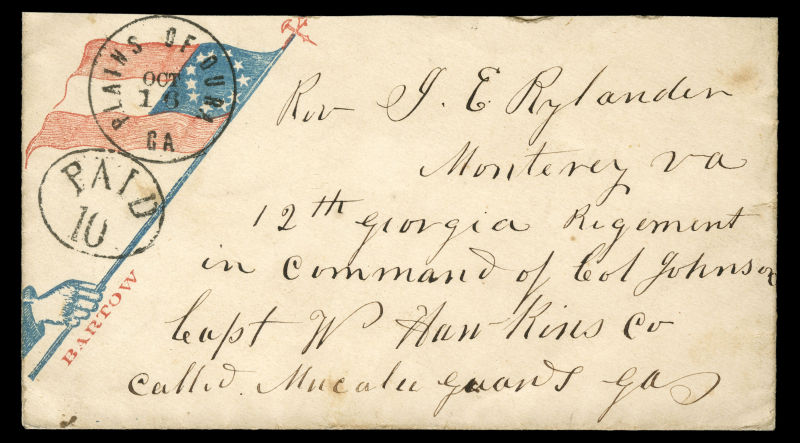
239 c   imagePlains of Dura, Georgia bold black “PAID 10” in oval handstamp and matching "Plains of Dura, Ga, Oct 16" (1861) on an outstanding red and blue 11-Star “Bartow” Confederate Flag patriotic stampless cover, addressed to “Rev. J. E. Rylander, Monterey, Va., 12th Georgia Regiment in command of Col. Johnson, Capt. W. Hawkins Co. called Makalee Guards.” A scarce Sumter County, Georgia patriotic usage showing the distinctive Plains of Dura handstamps on an early-war 10c rated cover addressed to the 12th Georgia Infantry in western Virginia. The year-date is confirmed by the military address - John Emory Rylander, then serving as 1st Sergeant of Company A (“Makalee Guards”) of the 12th Georgia, was transferred from the 12th Regiment to the 10th Georgia Battalion in May 1862, placing this usage firmly in 1861. The addressee, Rylander, a Methodist minister from a prominent local family, had been stationed with his unit at Camp Alleghany, where mail was routed through the Monterey, Virginia post office. He would later be promoted to Major in 1862 before being killed at Cold Harbor in June 1864. His father, Matthew Rylander, also a Methodist minister, founded the Rylander Methodist Church in Plains of Dura - a congregation and community that would later become part of the hometown landscape of U.S. President Jimmy Carter. The patriotic design is a tribute to Francis S. Bartow, the celebrated Georgia politician and militia captain killed at First Manassas, whose dying exhortation - “I go to illustrate Georgia” - became one of the most iconic rallying cries of the Confederacy. A very fine and historically rich Georgia patriotic from a small Deep South post office, combining a bold strike of the Plains of Dura handstamps, a desirable Bartow flag design, and a direct connection to early-war Virginia operations of the 12th Georgia Infantry. Plains of Dura, Georgia bold black “PAID 10” in oval handstamp and matching "Plains of Dura, Ga, Oct 16" (1861) on an outstanding red and blue 11-Star “Bartow” Confederate Flag patriotic stampless cover, addressed to “Rev. J. E. Rylander, Monterey, Va., 12th Georgia Regiment in command of Col. Johnson, Capt. W. Hawkins Co. called Makalee Guards.” A scarce Sumter County, Georgia patriotic usage showing the distinctive Plains of Dura handstamps on an early-war 10c rated cover addressed to the 12th Georgia Infantry in western Virginia. The year-date is confirmed by the military address - John Emory Rylander, then serving as 1st Sergeant of Company A (“Makalee Guards”) of the 12th Georgia, was transferred from the 12th Regiment to the 10th Georgia Battalion in May 1862, placing this usage firmly in 1861. The addressee, Rylander, a Methodist minister from a prominent local family, had been stationed with his unit at Camp Alleghany, where mail was routed through the Monterey, Virginia post office. He would later be promoted to Major in 1862 before being killed at Cold Harbor in June 1864. His father, Matthew Rylander, also a Methodist minister, founded the Rylander Methodist Church in Plains of Dura - a congregation and community that would later become part of the hometown landscape of U.S. President Jimmy Carter. The patriotic design is a tribute to Francis S. Bartow, the celebrated Georgia politician and militia captain killed at First Manassas, whose dying exhortation - “I go to illustrate Georgia” - became one of the most iconic rallying cries of the Confederacy. A very fine and historically rich Georgia patriotic from a small Deep South post office, combining a bold strike of the Plains of Dura handstamps, a desirable Bartow flag design, and a direct connection to early-war Virginia operations of the 12th Georgia Infantry. Plains of Dura, Georgia bold black “PAID 10” in oval handstamp and matching "Plains of Dura, Ga, Oct 16" (1861) on an outstanding red and blue 11-Star “Bartow” Confederate Flag patriotic stampless cover, addressed to “Rev. J. E. Rylander, Monterey, Va., 12th Georgia Regiment in command of Col. Johnson, Capt. W. Hawkins Co. called Makalee Guards.” A scarce Sumter County, Georgia patriotic usage showing the distinctive Plains of Dura handstamps on an early-war 10c rated cover addressed to the 12th Georgia Infantry in western Virginia. The year-date is confirmed by the military address - John Emory Rylander, then serving as 1st Sergeant of Company A (“Makalee Guards”) of the 12th Georgia, was transferred from the 12th Regiment to the 10th Georgia Battalion in May 1862, placing this usage firmly in 1861. The addressee, Rylander, a Methodist minister from a prominent local family, had been stationed with his unit at Camp Alleghany, where mail was routed through the Monterey, Virginia post office. He would later be promoted to Major in 1862 before being killed at Cold Harbor in June 1864. His father, Matthew Rylander, also a Methodist minister, founded the Rylander Methodist Church in Plains of Dura - a congregation and community that would later become part of the hometown landscape of U.S. President Jimmy Carter. The patriotic design is a tribute to Francis S. Bartow, the celebrated Georgia politician and militia captain killed at First Manassas, whose dying exhortation - “I go to illustrate Georgia” - became one of the most iconic rallying cries of the Confederacy. A very fine and historically rich Georgia patriotic from a small Deep South post office, combining a bold strike of the Plains of Dura handstamps, a desirable Bartow flag design, and a direct connection to early-war Virginia operations of the 12th Georgia Infantry. (Image)


Current Opening Price...$750.00
Will close during Public Auction
240 c   imageConfederate patriotic stampless cover depicting the “Flag of the South,” CSA national flag design with the letter “M” incorporated among the stars to denote Missouri as the Confederacy’s 12th state sent from Columbus, Kentucky and addressed to H. H. Jones, Esq., Col. Terry’s Regt., Care of Capt. Harrison, Bowling Green, Ky. Black Columbus, KY cds with illegible date at center tying lower corner of flag design. Cover with some edge restoration, which does not detract in the least from this stunning Confederate patriotic cover sent within Kentucky. This cover was sent during a very narrowly defined and politically charged window in the opening year of the Civil War. In late November 1861, the pro-Confederate Missouri government, meeting in exile after Union forces secured much of the state, was formally admitted to the Confederacy on November 28, 1861, as its symbolic twelfth member state. The incorporation of the letter “M” into the flag’s stars reflects this moment of Confederate optimism and political assertion, despite Missouri remaining deeply divided and largely under Union control. The cover is addressed to a private in "Col. Terrys Regiment," identifying the famed 8th Texas Cavalry, Terry’s Texas Rangers, one of the most renowned mounted units in Confederate service. Organized in the late summer of 1861 under Col. Benjamin Franklin Terry, the regiment was composed largely of seasoned frontiersmen and former Texas Rangers. By autumn 1861, Terry’s Rangers had been ordered east and assigned to Confederate forces under Gen. Albert Sidney Johnston, taking up station at Bowling Green, Kentucky, then the principal Confederate stronghold in the state. The notation “care of Capt. Harrison” refers to Thomas Harrison (1823–1901), initially serving as a captain and would later rise to the rank of brigadier general. Harrison had previously served in the U.S. Army during the Mexican-American War in the 1st Mississippi Rifles, commanded by Jefferson Davis who would go on to become President of the Confederacy. Colonel Terry was killed in action at Rowlett’s Station, Kentucky, on December 17, 1861, during one of the earliest cavalry engagements of the Western Theater. The regiment continued under his name after his death. Bowling Green itself was abandoned by Confederate forces on February 14, 1862, following Union advances in Tennessee, tightly constraining the mailing period of this cover to a brief interval from late November 1861 to early February 1862, and most plausibly to December 1861, when both the patriotic design and the address were fully contemporaneous. Patriotic covers displaying the 12-star flag and explicitly referencing Missouri’s Confederate admission are notably scarce, and examples addressed to elite field units in contested border-state theaters are especially desirable. The convergence here of Confederate political symbolism, early-war Western Theater military history, and a celebrated Texas cavalry regiment elevates this cover well beyond the ordinary patriotic genre. With 2007 CSA certificate. (Image)


Current Opening Price...$3,000.00
Will close during Public Auction

Previous Page, Next Page or Return to Table of Contents


StampAuctionNetwork® is a registered trademark of Droege Computing Services, Inc | StampAuctionCentral and StampAuctionNetwork® are Copyright © 1994-2026 Droege Computing Services, Inc. All Rights Reserved. | Mailing Address: 20 West Colony Place, Suite 120, Durham NC 27705 | If you want to talk to me about anything other than selling your stamps, call 919-403-9459 and ask for Tom Droege, or email support@stampauctionnetwork.com We can help you evaluate or sell your collection so... Click here for help selling your Collection. Once you follow the instructions we can talk. But first we have a process. Sign up for a paid or free membership | Lost your Links? Return to StampAuctionNetwork® | Instructional Videos - Master StampAuctionNetwork® | Sign up for our Newsletter | Terms and Conditions.