You are in StampAuctionNetwork Unattended Live Bidding
. Note that by using SAN Unattended Live Bidding, you understand
that if your bid is successful, you will be invoiced at 1% of the Realized value, no cap and no minimum.
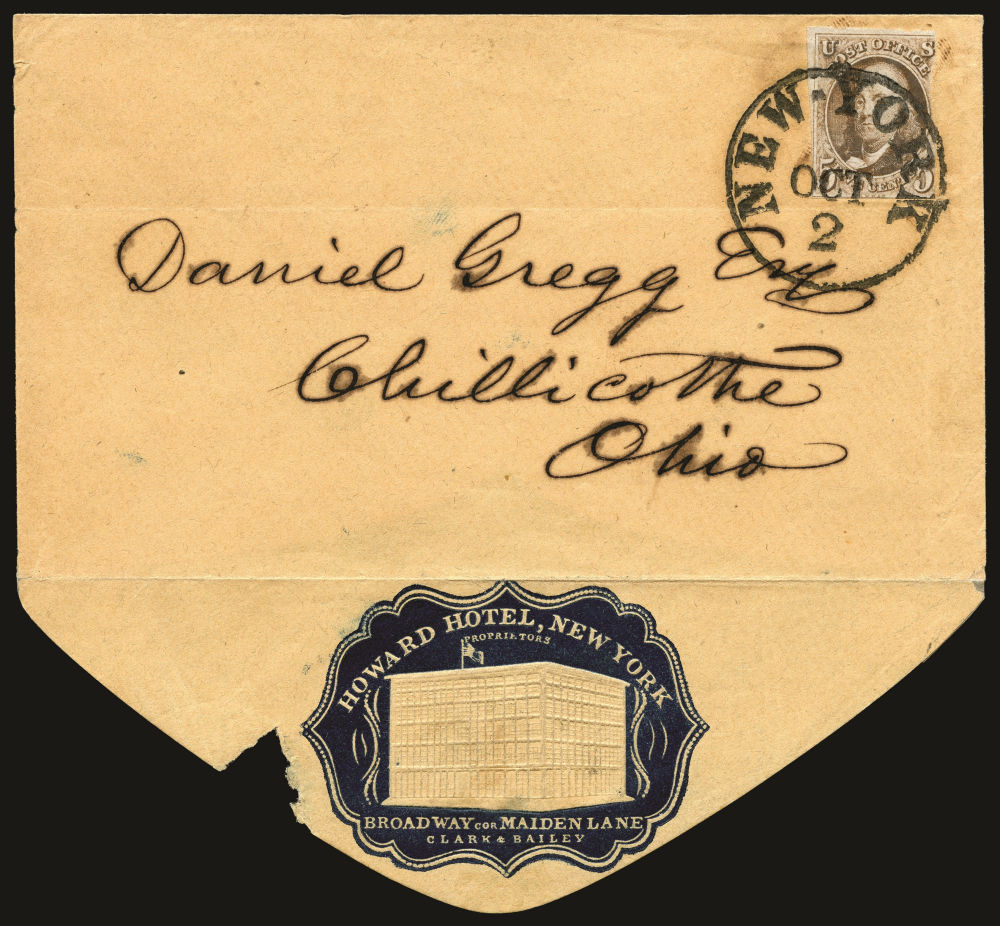
(1) 1847-51 5¢ red brown Franklin, deep shade from a cleaned plate, tied by an exceptionally sharp strike of a black "New-York Oct. 2 (1851)" cds on cover addressed to Daniel Gregg in Chillicothe, Ohio. The stamp shows three margins and is roughly separated into the design at right. The reverse bears a striking Howard Hotel blue cameo design with embossed illustration of the hotel building and "Clark & Bailey" imprint. A small piece is missing from the backflap and there is a pressed vertical file fold not affecting the stamp.
A beautiful and rare example of demonetized usage of the 1847 Issue, accepted after the July 1, 1851 deadline and used here to pay the new 3¢ rate. Notably, the black New York cds was never used during the valid period of the 1847 Issue and confirms the illegitimacy of this franking. The sender, likely aware of the new reduced rate for under-3,000-mile letters, evaded paying postage by using a no-longer-valid 5¢ stamp that was nonetheless accepted.
Another demonetized 1847 Issue cover bearing this elaborate cameo corner card addressed by the same sender to Daniel Gregg in Chillicothe is known, dated one week earlier on September 25, 1851. A highly desirable cover combining a demonetized use, bold postal markings, and an outstanding hotel advertising design.
Ex. Gross, signed Ashbrook, notes by Dr. Carroll Chase on reverse, with 2017 Philatelic Foundation certificate.
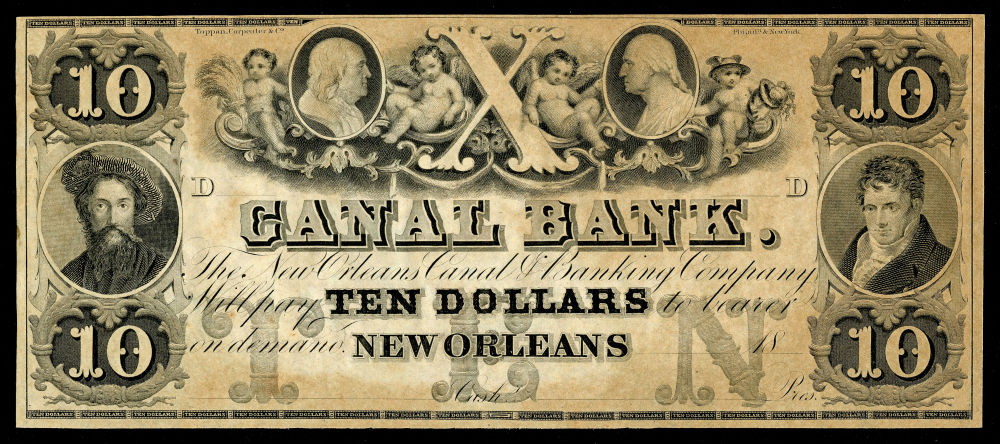
Two Toppan, Carpenter Canal Bank banknotes showing examples of the original dies used to prepare the (7/10A/17) 1851-57 1¢, 3¢ & 12¢ stamp plates previously deployed in the production of banknotes by the firm. Used examples of 1¢, 3¢ & 12¢ 1851-57 Issue stamps included on original exhibit page.
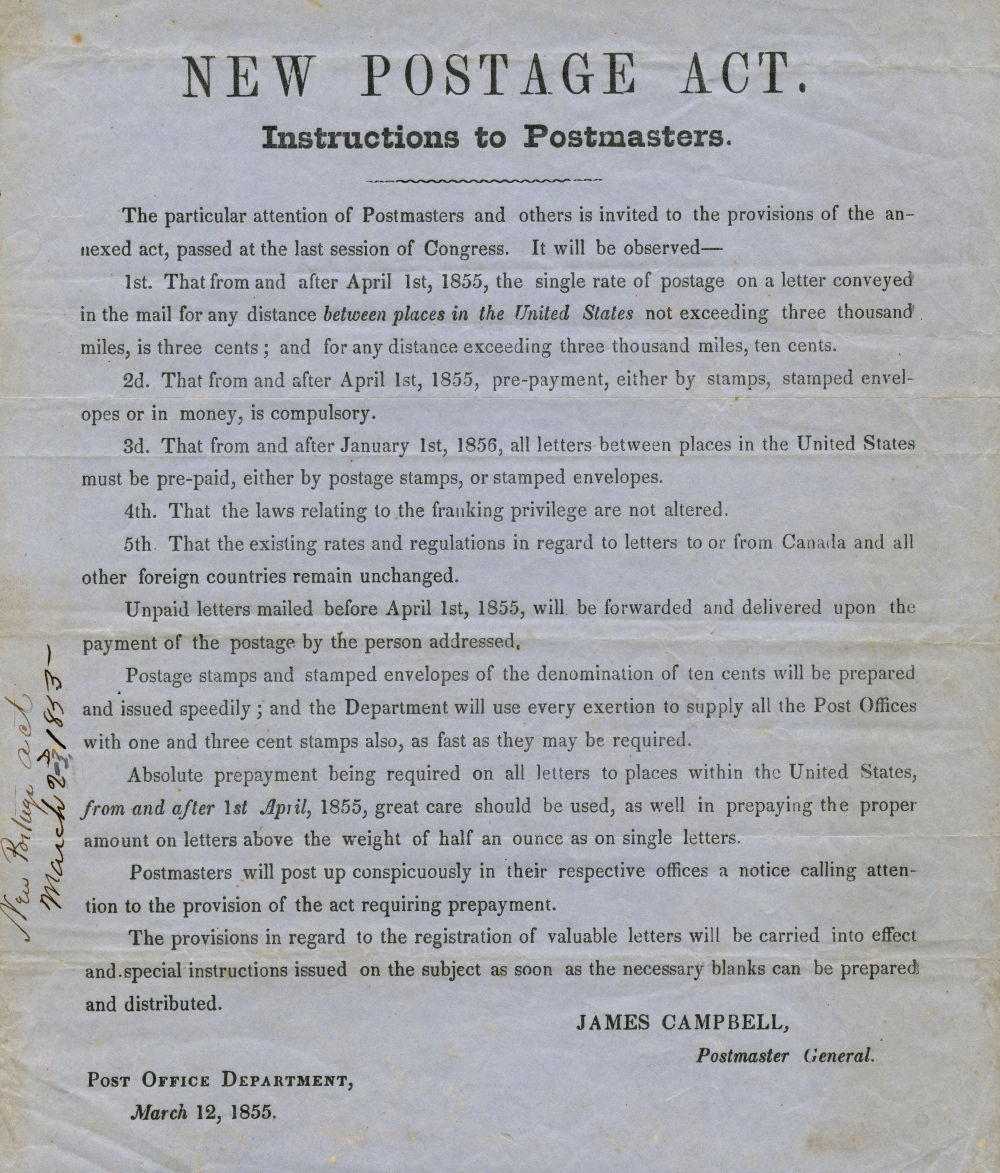
Two-page official printed notice from the U.S. Post Office Department (7 7/8" x 10") detailing one of the most significant postal reforms of the 19th century. Issued by Postmaster General James Campbell and dated March 12, 1855, this notice was circulated nationwide to inform postmasters of the sweeping changes enacted by Congress and approved March 3, 1855.
Both sheets exhibit normal folds and mild handling wear. An excellent collateral item - essential for postal historians and collectors of classic U.S. issues and stampless-era material.
Ex. Honolulu Advertiser and Golden, described by Thomas A. Alexander and pictured in USPCS Chronicle 132 (Nov 1986).
Transcript: The first sheet, headed "NEW POSTAGE ACT. Instructions to Postmasters.", outlines the practical implications of the new law, including:
Effective April 1, 1855, the single rate of postage on a letter traveling under 3,000 miles is 3 cents, and 10 cents for distances over 3,000 miles.
From the same date, pre-payment of postage became compulsory, whether by postage stamps, stamped envelopes, or in money.
As of January 1, 1856, all letters between places in the United States must be prepaid exclusively with stamps or stamped envelopes.
The notice also affirms that franking privileges remain unchanged and foreign rates continue as before.
Instructions are included for the preparation and distribution of 1¢, 3¢, and 10¢ stamps and for the registration of valuable letters.
The second sheet prints the full text of the New Postage Act, codifying these reforms into law. It also imposes double and triple charges for heavier letters, mandates a 1¢ fee on drop letters, and authorizes—but does not require—the registration of letters for a 5¢ fee.
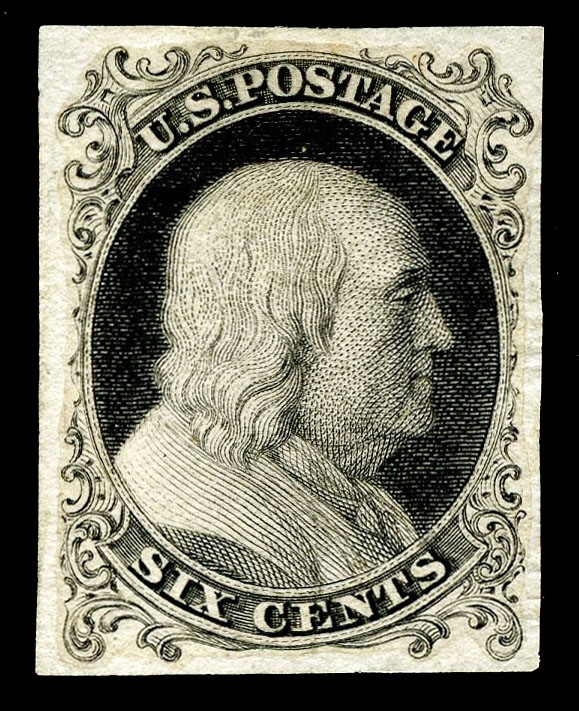
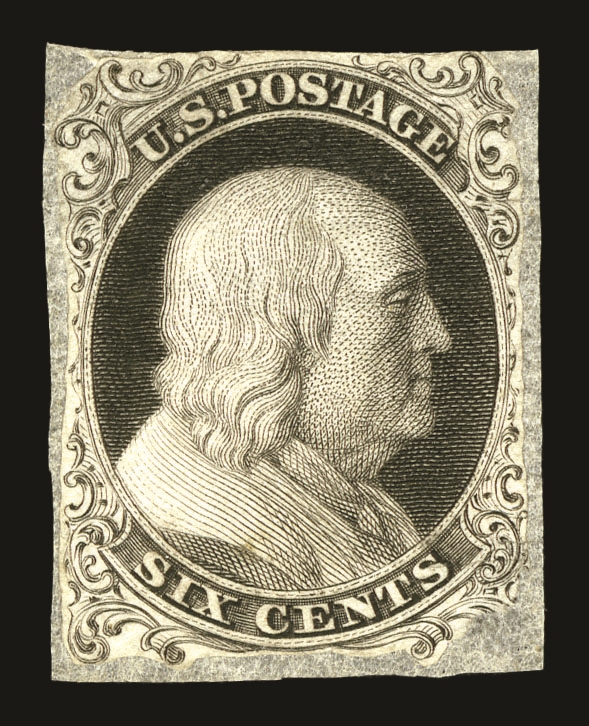
(5-E2) 1851 6c black Toppan, Carpenter, Casilear & Co. "Six Cents" die essay on india paper, cut to shape and mounted on paper backing, fine-v.f. overall appearance of this hard to fine essay from the 1851 competition to secure the contract to produce U.S. postage stamps.
(5-E2) 1851 6c black Toppan, Carpenter, Casilear & Co. "Six Cents" die essay on india paper, cut to shape and mounted on tissue paper backing, fine overall appearance of this hard to fine essay from the 1851 competition to secure the contract to produce U.S. postage stamps.
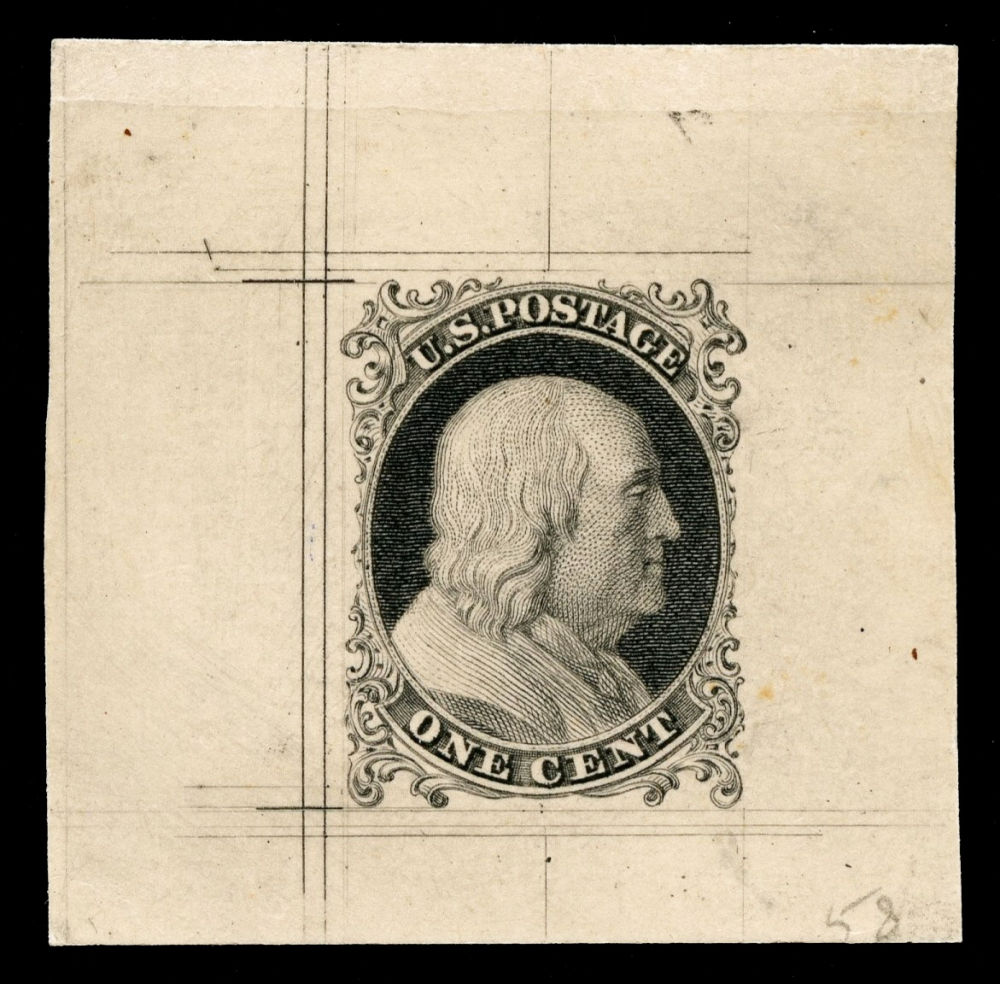
(5TC1ae) 1851 1¢ Franklin large die proof, printed in black on India paper (45 x 45mm), die sunk on full-size card. The design features include extended guidelines reaching from the printed frame onto the card at top and bottom, indicating early production use. Bold impression on crisp, bright paper. Light pencil “58” at lower right is likely a Bureau of Engraving & Printing archival control or inventory notation.
This example bears the distinctive cancellation dot in the oval at left, applied to the die in 1860 and carried through onto Plates 11 and 12. Additional diagnostic features—two small dots beneath the “C” of “CENT,” and the strong horizontal layout line at upper left—are not present on Plates 1–12 but are found on proofs from the 1875 Reprint plate. These elements support the conclusion by Neinken and Ashbrook that this impression was pulled from a die prepared for the 1875 Reprint, and likely distributed by the Bureau of Engraving & Printing around 1910.
One of only five recorded proof impressions from the one-cent 1851 die—a major rarity, with two known in blue and three in black. A significant item for specialists focused on the 1851 Issue and U.S. classic proof material.
Ex Ashbrook & Eubanks; illustrated in Ashbrook’s One-Cent Book (Vol. 1, p. 53) and the Neinken revision (p. 19).
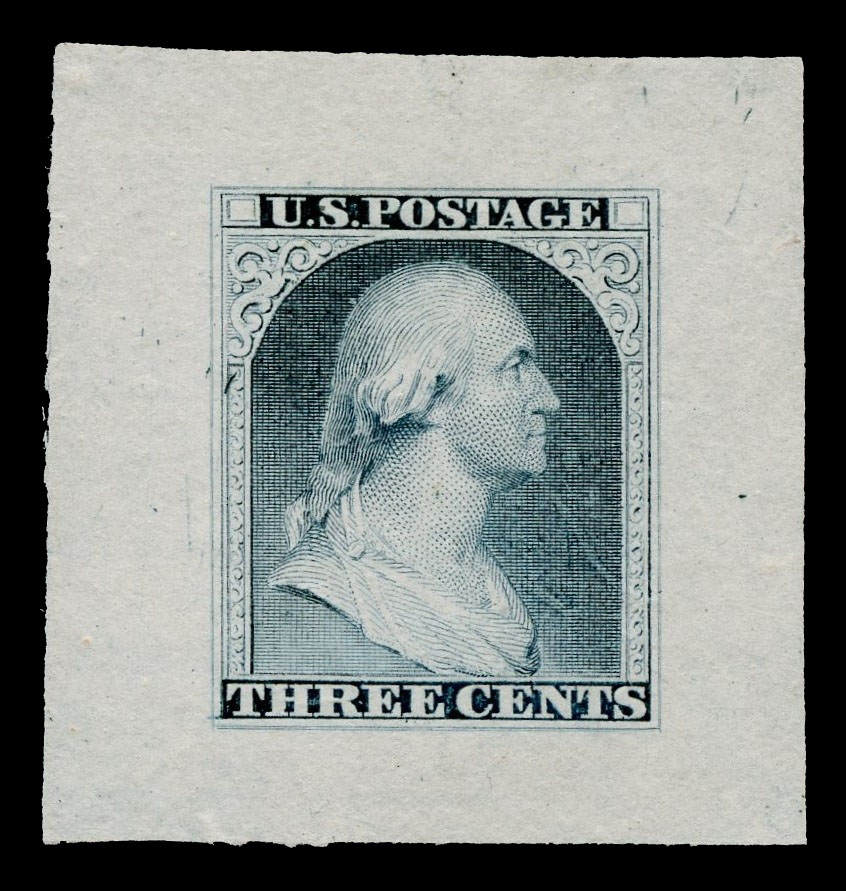
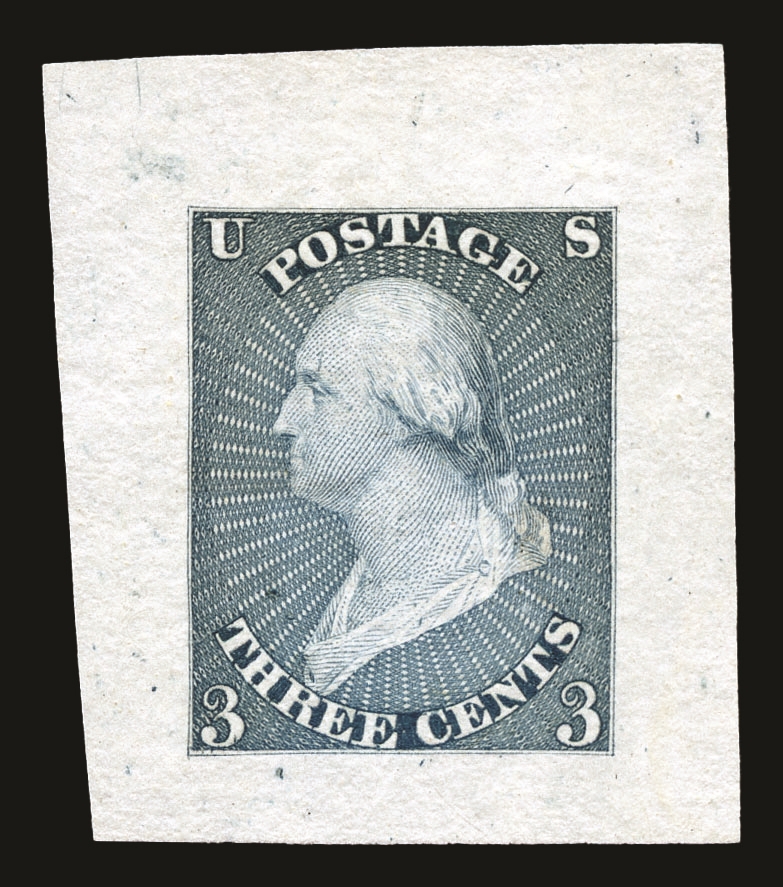
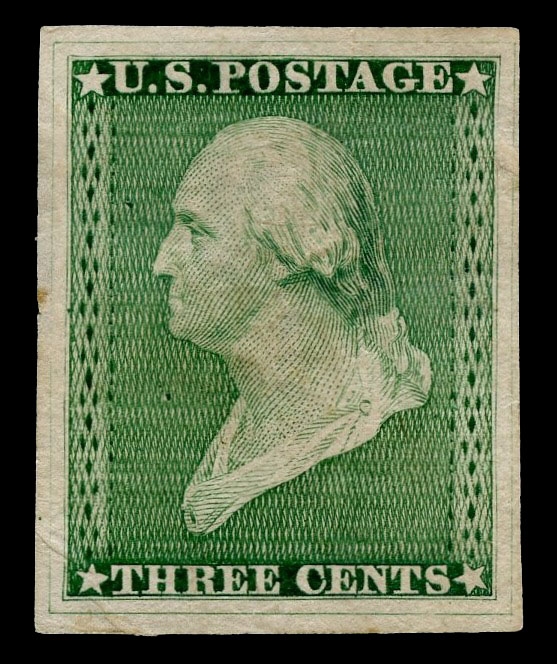
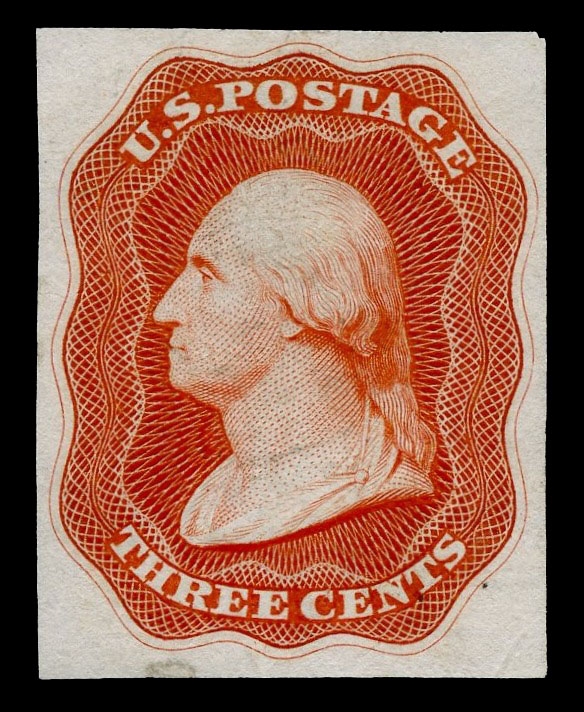
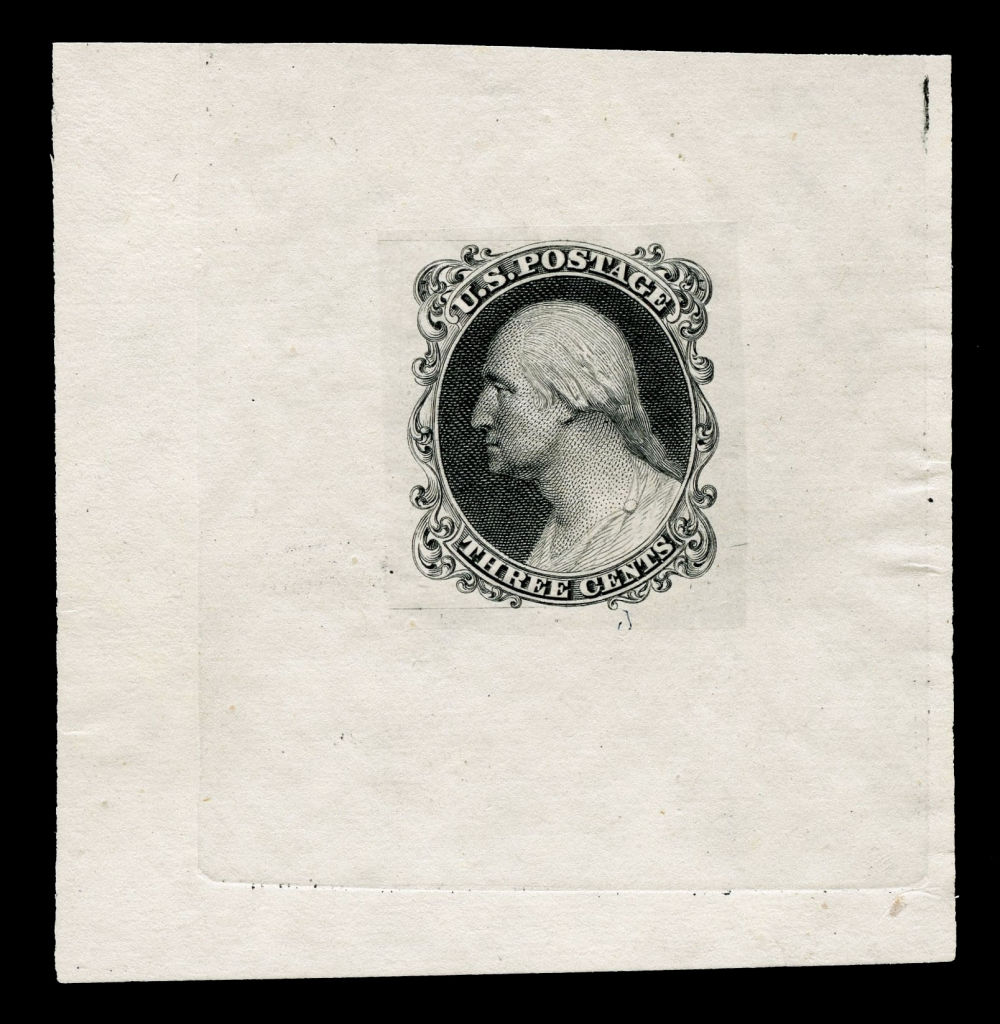
Group of nine Toppan, Carpenter & Co. 3c Washington 1903 Schernikow die essays including 11-E17c, 65-E1a, 65-E1c, 2x 65-E2b and 4x 65-E3c. A very fine assemblage of these interesting die essays produced from the original dies by Schernikow.
(24P3) 1857-61 1¢ blue Franklin Type V, position 3L9, plate proof on India paper, small thin spots but still a fine-v.f. and scarce example of this 1¢ plate proof.
With 1988 Philatelic Foundation certificate, cat. value $1,250.
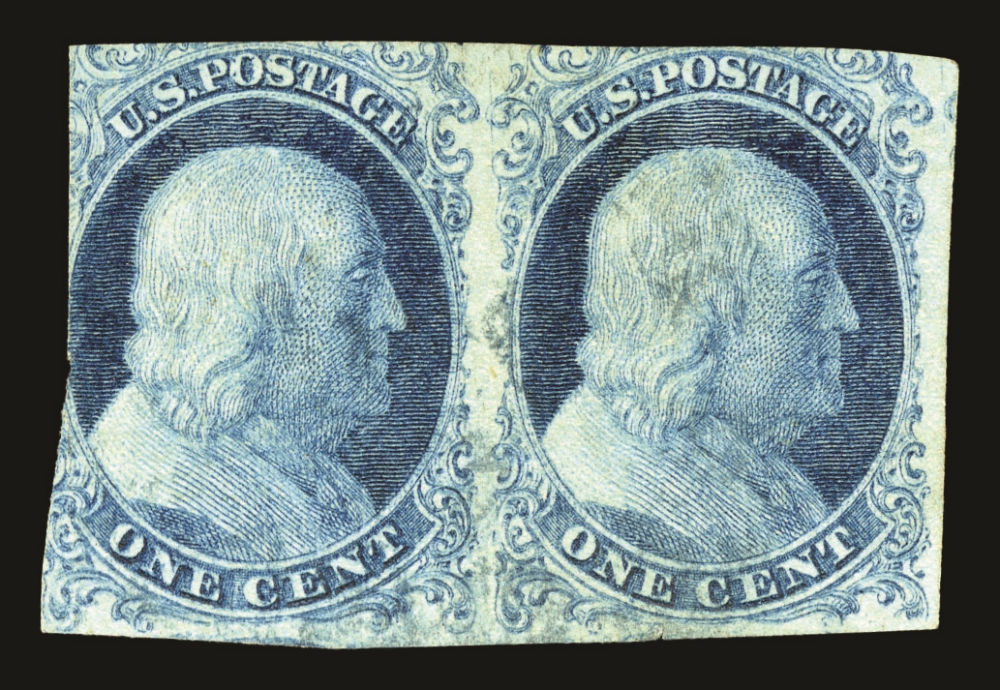
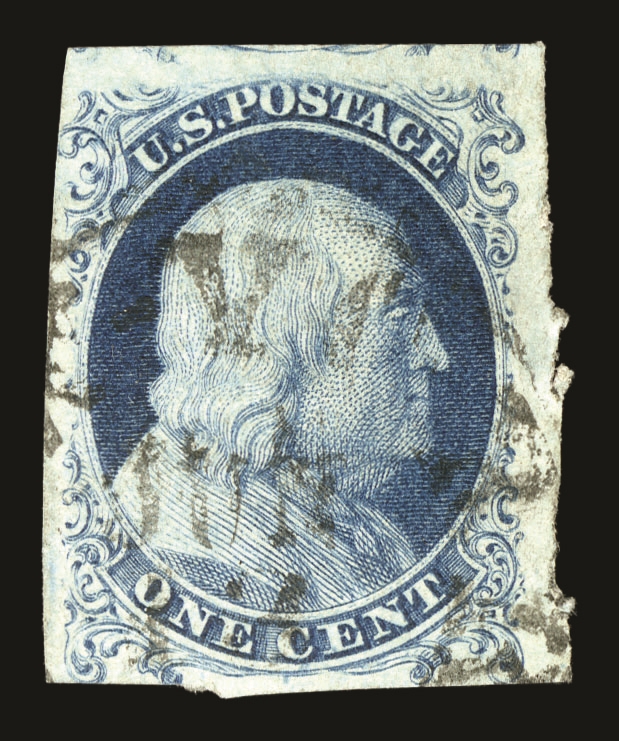
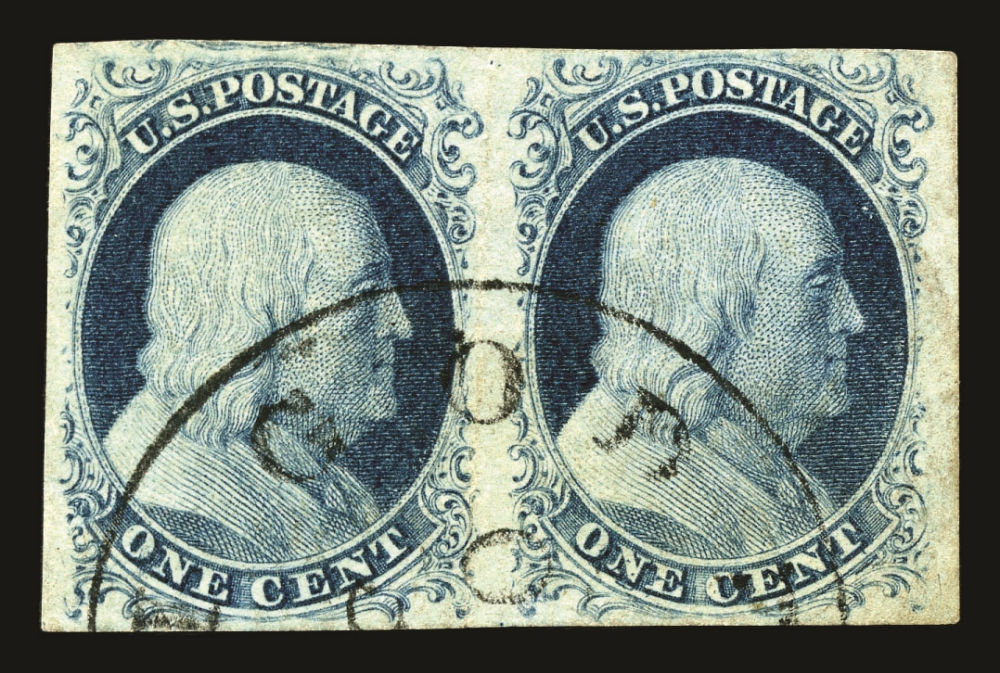
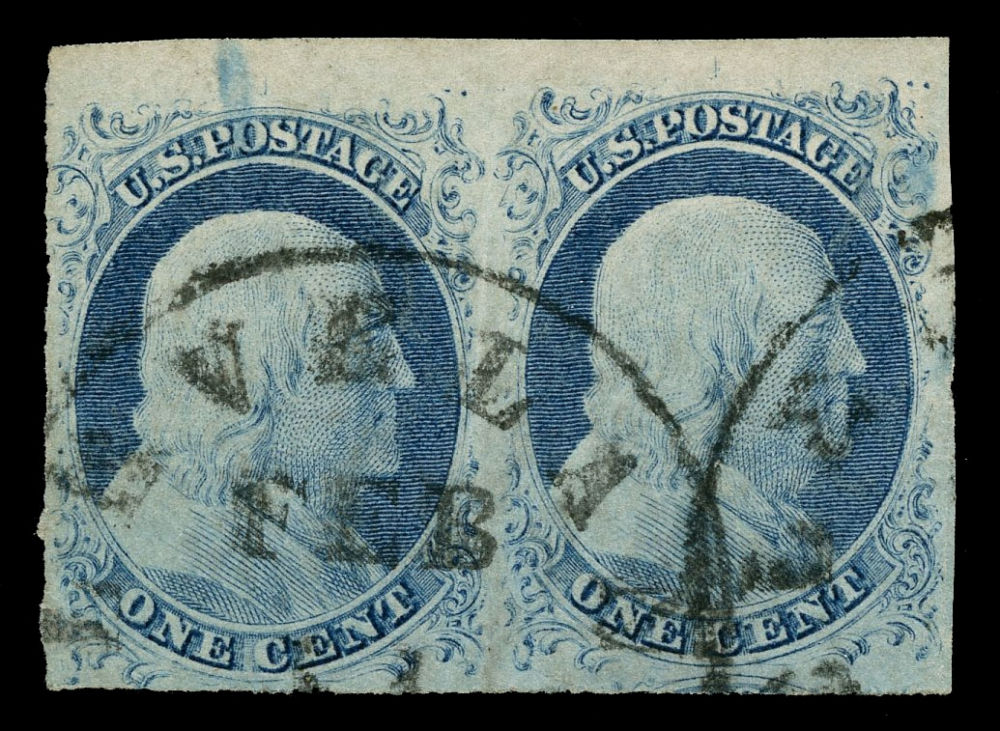
(5/5A) 1851-57 1¢ blue Franklin combination Type I-Ib used, positions 7R1E-8R1E, horizontal pair with a light cancel exhibiting a distinct darker blue shade from a later printing. (5) Type I stamp featuring full design at right with margin in at left. (5A) Type Ib with small tear at bottom. Only 98 Type I stamps are known to exist with seven used 5/5A combination pairs and ten strips of three (on and off cover) recorded in the Wagshal Census. The full design visible at the bottom and right of the Type I stamp makes this a particularly desirable item.
Wagshal Census No. 5-MUL-59 with 1975 Philatelic Foundation certificate noting "right stamp with a tiny nick in bottom margin" and 2025 PFC noting "right stamp with a small tear at bottom," cat. value $85,000.
Background on imperforate 1c Franklin Type I and sub-types:
After a few entries with the transfer roll on Plate 1 Early, the siderographer realized the spacing and relief size required adjustment.
Type I: Full die design, but lower right ornaments may be weak. 7R1E (7th top row position from left, right pane, Plate One Early) is the only Type I position on the plates used for imperforate stamps.
Type Ib: As Type I but lower right ornaments are incomplete.
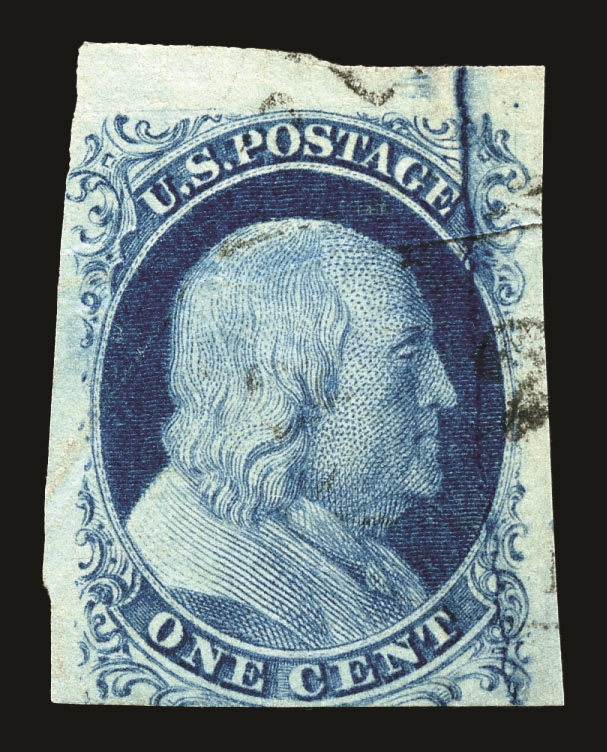
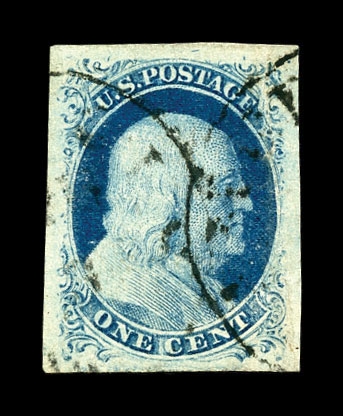
(5A) 1851-57 1¢ blue Franklin Type Ib, position 5R1E, used with partial black cds cancel, exhibiting a double transfer in the "ONE CENT", fair margins, touching at bottom and in at top, fine and in sound condition. Only six positions on Plate 1 Early are Type Ib.
With 2025 Philatelic Foundation certificate, cat. value $6,000.
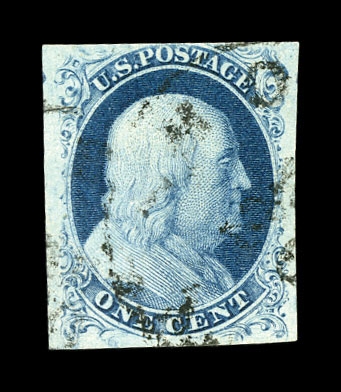
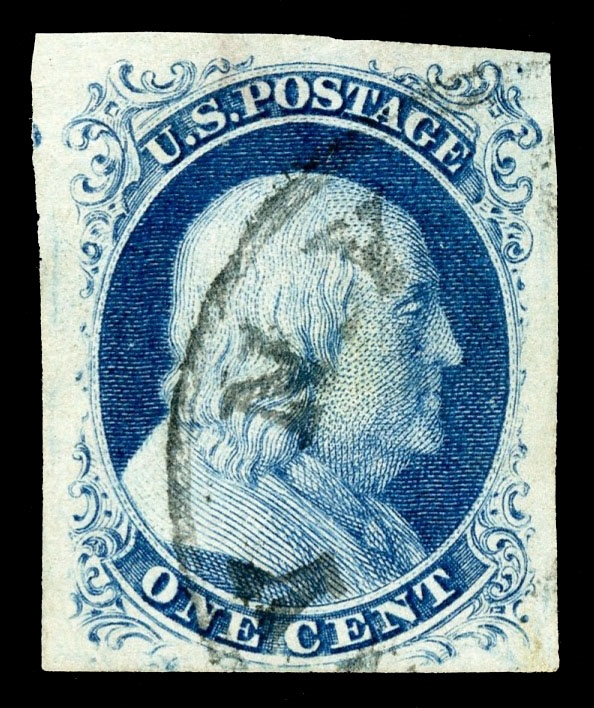
(6) 1851-57 1¢ blue Franklin Type Ia, position 100L4, used with partial town cds cancel and nice margins on three sides to just touching at scrolls at bottom. A very fine example and hard to find in sound condition.
Ex. Rosenthal & Hansen, accompanied by part printed circular it was originally used on, with 1983, 2002 & 2025 Philatelic Foundation certificates, cat. value $9,250.
(6b) 1851-57 1¢ blue Franklin Type Ic, position 49L4, used with partial town cds cancel, nice margins on three sides to just touching at top, small diagonal crease at bottom left but still a fine example of this hard to find stamp.
Ex. Celler, with 2025 Philatelic Foundation certificate, cat. value $4,250
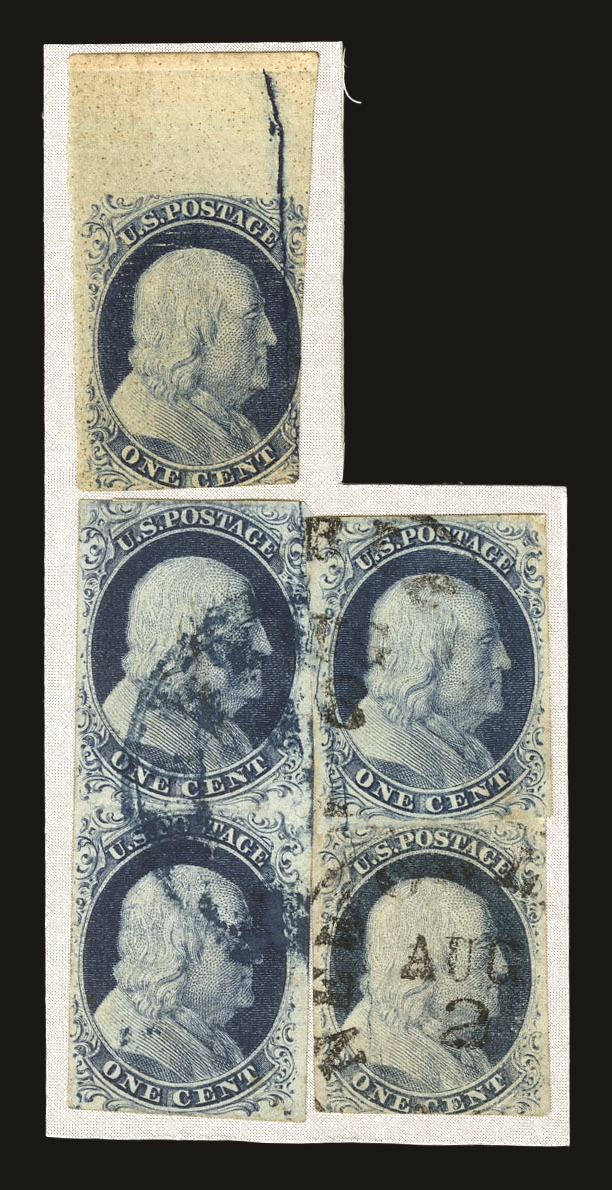
(7) 1¢ blue Franklin Type II, positions 2L2, 12-13L2 & 22-23L2, mounted reconstruction of major cracked plate variety including the “”Big Flaw”” most easily visible with position 2L2 into the top sheet margin. The top sheet margin position 2L2 is unused with original gum, a tiny lower left corner crease and light toning specks on front. The other four stamps are used, positions 12-22L2 are a vertical used pair with a blue CDS cancel and the remaining two stamps are used with black CDS cancels. The plate crack begins above position 2L2 in the sheet margin visible into the stamp’s design and then slopes at a slight diagonal affecting positions 12 13L2 and 23L2. A desirable reconstruction of this well-known 1c Plate 2 major plate crack.
With 2009 APS certificate, cat. value $2,720 as three major cracked Plate 2 stamps (one unused, two used), one used intermediate cracked plate stamp and one regular used Type II stamp.
Background: The plate crack across positions 2L2, 12-13L2 & 23L2 represents an example of quality control issues with production of the stamps, but no record of complaints from the government have surfaced. The printers - Toppan, Carpenter, Casilear & Co. hoped to avoid producing new plates. Each plate cost about $500 (in 1850s dollars) to make.
(7) 1851-57 1¢ blue Franklin Type II Plate 3 “Forked Lightning” crack reconstruction comprising positions 24L3, 33L3, and 34L3. The top stamp, 24L3, is a used example with full to large margins and a bold strike of the New York CDS dated October 5, 1857. The lower two stamps, 33L3 and 34L3, are rare unused without gum singles with ample to large margins - 34L3 in sound condition and 33L3 with a small thin. All three stamps exhibit rich, intense color and are well-suited for illustrating the dramatic “Forked Lightning” plate crack that runs through this portion of the left pane of Plate 3.
A very fine and desirable reconstruction of one of the most famous plate flaws of the 1c 1851 57 Issue, as chronicled by Ashbrook and later refined by Neinken (see Neinken, pp. 228–229). Examples from this crack - especially unused - are rare and highly sought after, and this trio, selected by Neinken himself, represents an exceptional presentation of this iconic plating variety.
Ex Neinken & Wagshal, Scott does not list a price for unused major plate crack stamps, cat. value $2,475 as three used stamps.
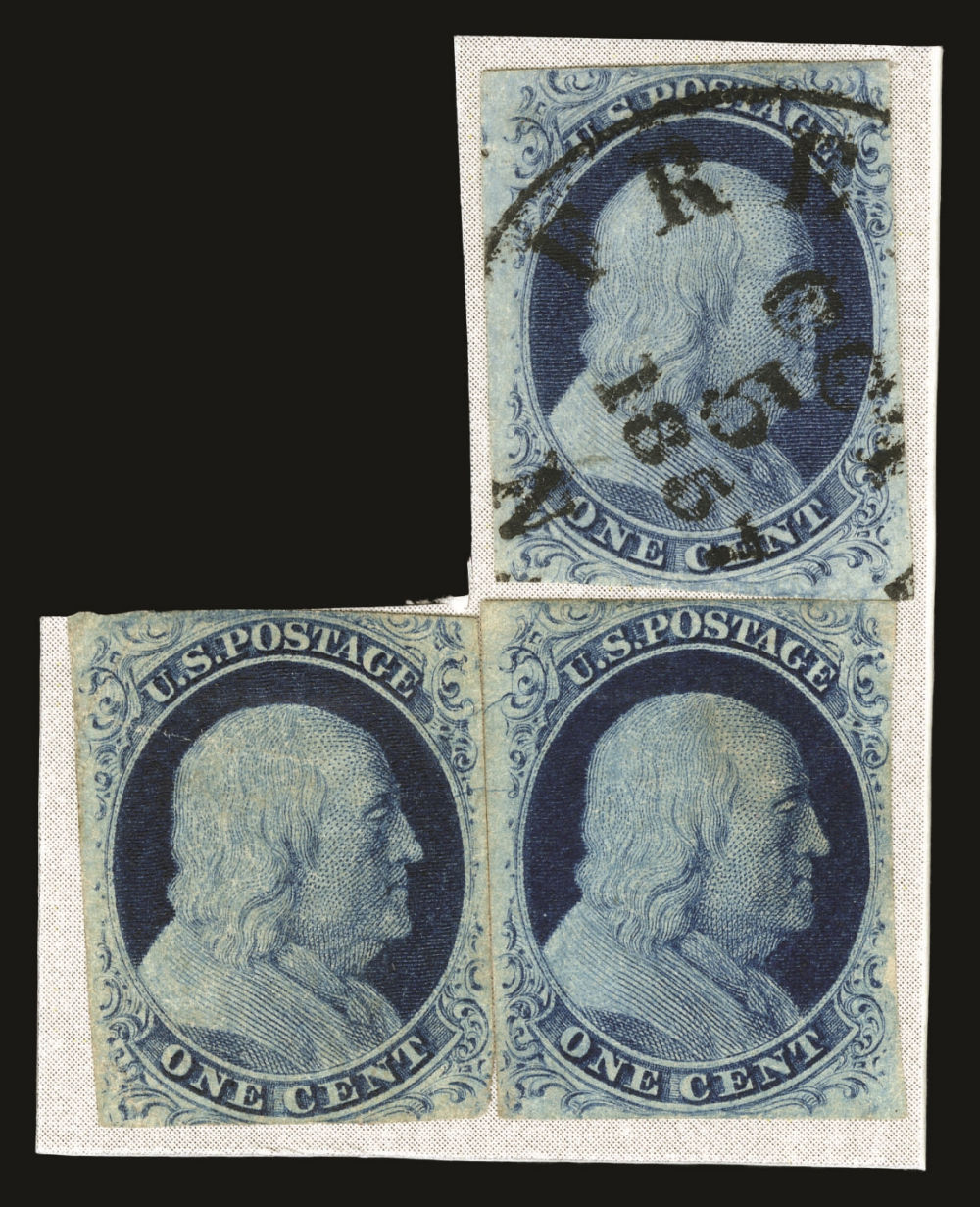
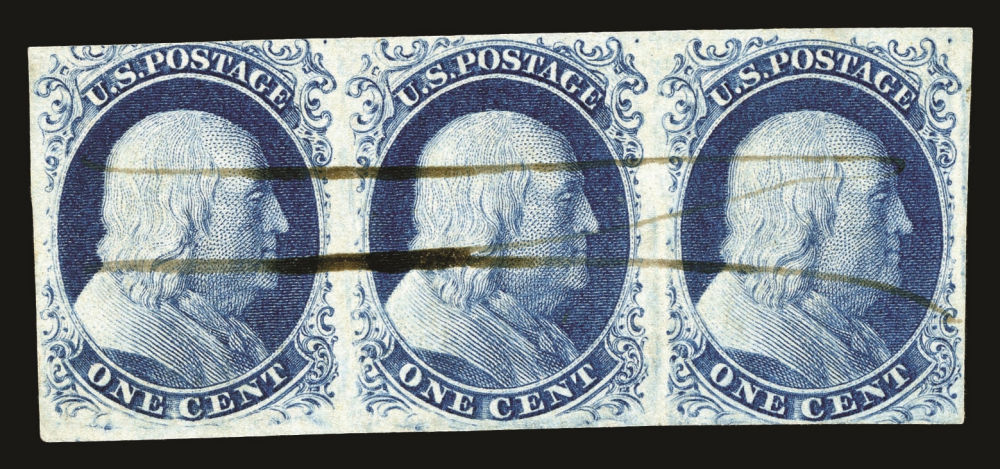
(7) 1851-57 1¢ blue Franklin Type II horizontal strip of three from the top row of Plate 4, plated by Wagshal as Positions 2-4L4 and confirmed by PF certificate (Ashbrook plated as 4-6L4 with pencil note on reverse), tied by manuscript pen stroke cancels on piece. Plate 4 produced some of the finest and most complete Type II impressions. A scarce and visually striking strip in sound condition, particularly desirable for its plating significance and display of complete Type II characteristics.
Ex Cowitt, Wagshal & Eubanks, with 2025 Philatelic Foundation certificate, cat. value $3,000 as Type II Plate 4 pair and single.
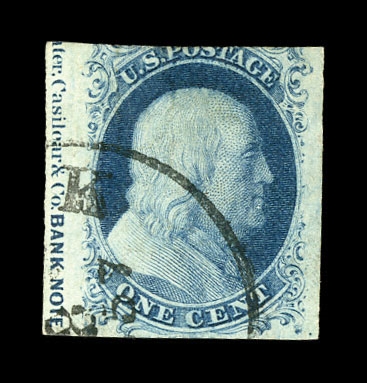
(7) 1851-57 1¢ blue Franklin Type II, position 41L3, showing part of a Type Ia imprint “nter Casilear & Co. BANK NOTE” at left, nice margins to in at top, with deep rich color and crisp impression. Struck by a partial CDS with clear "57" from year date. A fine Plate 3 captured imprint single in sound condition.
Ex. Saadi, with 1992 Philatelic Foundation certificate, cat. value $360 for non imprint stamp.
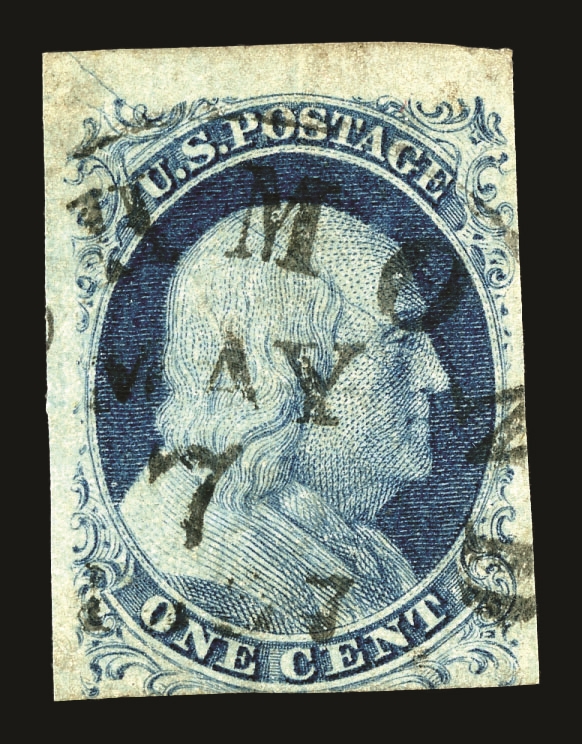
(7) 1851-57 1¢ blue Franklin Type II, position 8R3, top sheet margin single showing the prominent Plate 3 crack starting in the sheet margin and coming down across Franklin's head, used by a partial "Richmond May 7" cds. A very fine example of this distinctive Plate 3 plate crack variety with sheet margin at top in sound condition.
With 2025 Philatelic Foundation certificate, cat. value $825.
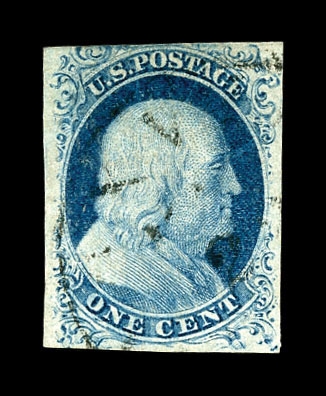
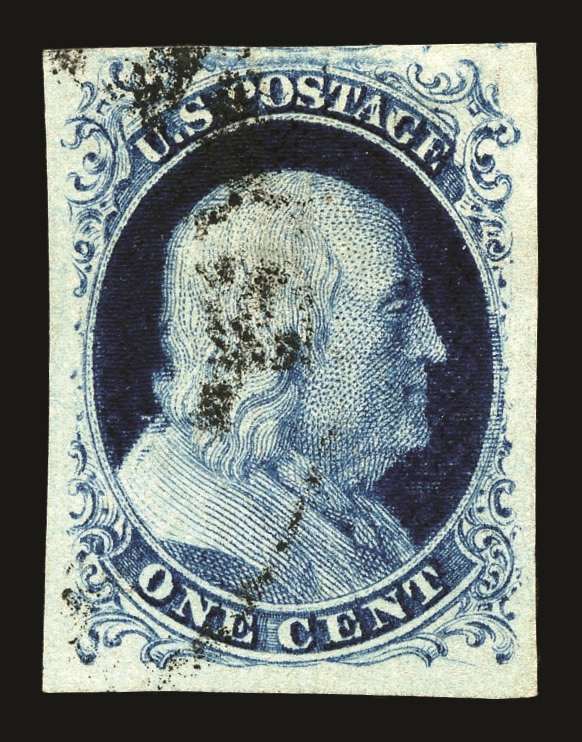
(7) 1851-57 1¢ blue Franklin Type II, Position 9R4, used by partial black cds cancel and exhibiting complete design at top and margins all around including small part of stamp at left showing. Small corner crease at top right does not diminish from the overall very fine appearance of this 1¢ Type II stamp from Plate 4.
With 2000 Philatelic Foundation certificate, cat. value $900.
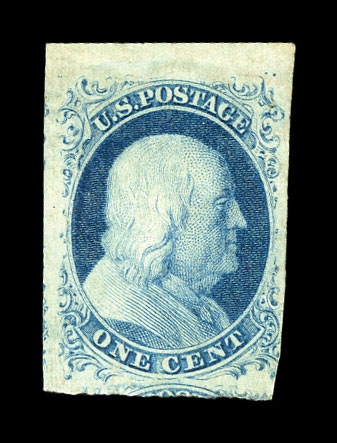
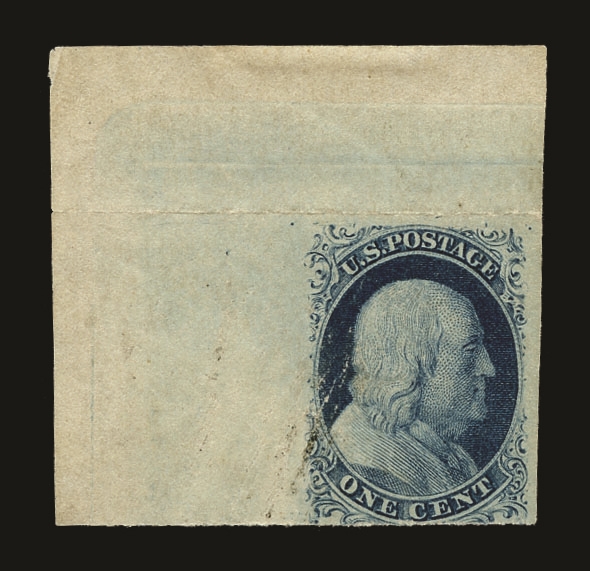
(7 var) 1851-57 1¢ blue Franklin Type II, Position 4R1L, unused with original gum top sheet margin single with part of the stamps at left and bottom visible and showing the distinctive characteristics of this important position on the plate.
Position 4R1L is the only Type II position on Plate 1L, created when the plate was extensively re-entered—strengthening nearly all 200 positions except this one, which retained its full design at top but lost some of the bottom ornamentation. This position also shows one of the most prominent double transfers on the plate, adding to its desirability. Very few 1¢ Type II Position 4R1L stamps are known in sound condition retaining their original gum.
A key position piece for 1¢ 1851–57 specialists, offering a combination of rarity in this condition, plating significance, and overall visual appeal.
With 2025 Philatelic Foundation certificate, cat. value $2,000.
(7) 1851-57 1¢ blue Franklin Type II horizontal pair, positions 89–90R3, right stamp showing double transfer, large to ample margins, light crease between stamps, otherwise a very fine and scarce Plate 3 multiple.
Ex. Eubanks, with 2001 APS certificate, cat. value $820.
(7) 1851-57 1¢ blue Franklin Type II, position 2L2, used top sheet margin single exhibiting major crack plate variety from the sheet margin down at right. A diagonal crease at left going to the top and horizontal crease noted, neither of which detract from this desirable major cracked plate position stamp, fine-v.f.
With 2025 Philatelic Foundation certificate, cat. value $450.
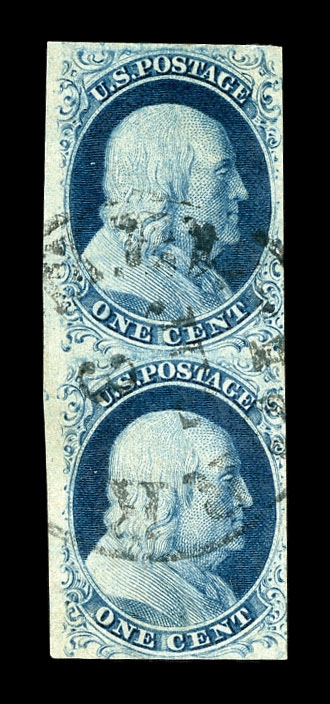
(7) 1851-57 1¢ blue Franklin Type II, position 64-74L3, vertical pair from Plate 3 used by a partial New York cds cancels, large margins at left to touching at right, a fine-v.f. overall Plate 3 vertical pair in sound condition.
With 2025 Philatelic Foundation certificate, cat. value $775.
(7) 1851-57 1¢ blue Franklin Type II, position 1L2, used single with traces of misplaced transfer relief visible at top, huge margins all around, vertical crease at right does not detract from the stunning overall appearance of this top left corner stamp from Plate 2.
(7 var) 1851-57 1¢ dark Prussian blue shade Franklin, position 100R3, exhibiting double transfer and small plate crack used by black town cds, very fine.
With 1990 Philatelic Foundation certificate, cat. value $460+
(7/9) 1851-57 1¢ blue Franklin Type II-IV, position 4R1L-5R1L used horizontal pair with sheet margin at top and vertical crease affecting the left stamp. The left stamp (7, Pos. 4R1L) is the only non-recut position, Type II on Plate 1 Late. The right stamp (9, Pos. 5R1L) is a Type IV stamp and has been recut one at bottom. A wonderful example of the Type II & Type IV designs side-by-side in a sheet margin horizontal pair.
With 2025 Philatelic Foundation certificate, cat. value $650.
(7) 1851-57 1¢ blue Franklin Type II plating group from Plates 2 and 3, featuring 26 stamps in singles, pairs, a block of four, and one cover—all plated and identified by Robert Boyd.
From Plate 2, the left pane material includes: 1L2, unused without gum corner sheet margin single and 9–10/19–20L2, unused without gum block of four, both with faults; 13L2 and 23L2, each showing cracked plate varieties and accompanied by APEX certificates; 32–33L2 horizontal pair; and a second 33L2 example with extension of flaw. The right pane of Plate 2 includes: 27R2; 48R2, a major double transfer; 50R2; 56–57R2 pair; 69R2; 79R2 with two dots in upper right; and possibly 97R2. Also present are 90–100R2, a vertical pair, and 100R2 on cover with APEX certificate. From Plate 3, the left pane features 23L3 and 33L3, the latter showing the distinctive “Forked Lightning” plate crack. From the right pane of Plate 3 is 89–99R3, a vertical pair with bottom sheet margin, 99R3 showing faint diagonal plate cracks.
An appealing and well-documented plating group of 1¢ Franklin Type II stamps, offering a useful foundation for the study of Plates 2 and 3, with numerous premium positions and varieties. Faults here and there to be expected but overall fine-v.f. A valuable lot for the serious student of the 1851–57 Issue.
Cat. value $15,000+ with unused block of four counted as unused o.g. as Scott does not list an unused without gum block of four value.
(7 var) 1851-57 1¢ blue Franklin Type II, position 48R2, used in sound condition with a light, unobtrusive partial black "Chicago Ill Sep 2 (1856)" cds and very fine centering within the famous Chicago private 12 ½ perforations invented by Dr. Elijay W. Hadley.
In 1997, W. Wilson Hulme II across two articles (Chronicle 175, May & Aug. 1997) set out to explain the origins of the Chicago private perforations on 1851 Issue 1¢ & 3¢ stamps. His work built upon the research published by Jerome S. Wagshal in the Chronicle in 1986. In the second article, Hulme established a census of the known 1¢ examples on and off cover. Approximately 18 examples of the 1c Chicago Perf stamps have been recorded with 12 being Type II. The example offered here is easily one of the finest known of the 1c Type II stamps with Chicago Perfs.
Ex. Hulme (realized $7,000 hammer in 2008 sale), with 1998 & 2009 Philatelic Foundation certificates, cat. value $8,000.
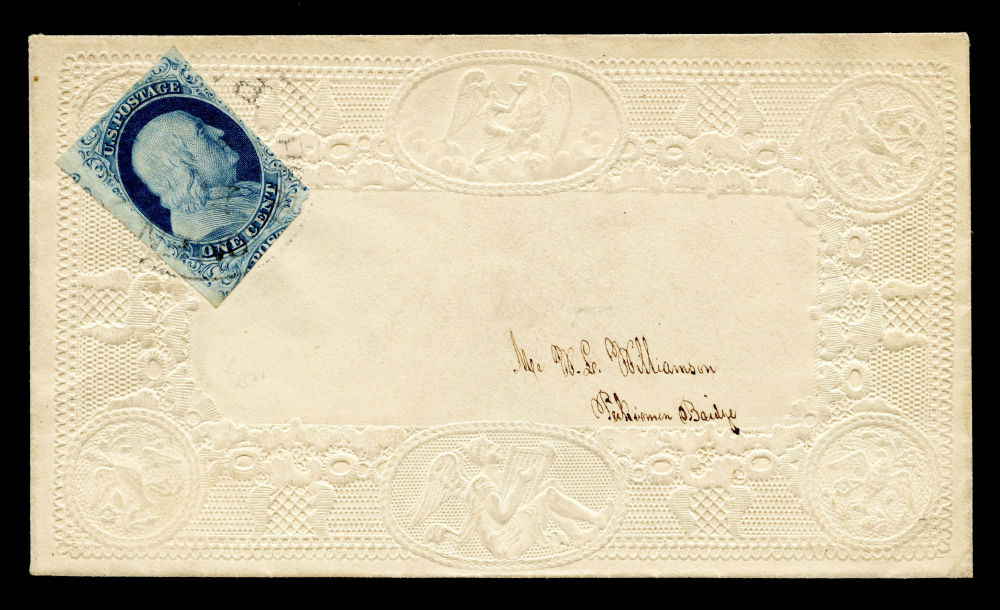
(7) 1851-57 1¢ blue Franklin Type II tied by Perkiomen Bridge, Pennsylvania cds with indistinct date on embossed Valentine drop-rate cover to Miss Williamson. The envelope is ornately embossed with a lacework border and vignettes of cherubs and eagles, framing the address panel. Enclosed is the original lace Valentine card, with embossed trees, scalloped edges, and a central hand-colored rose motif above a gilt-printed motto: “The heart that is nearest attached to the flower, is always the first that’s wounded by the thorn.”
A beautifully preserved and visually striking example of early Valentine correspondence, enhanced by its desirable solo 1851 1¢ Issue franking, very fine.
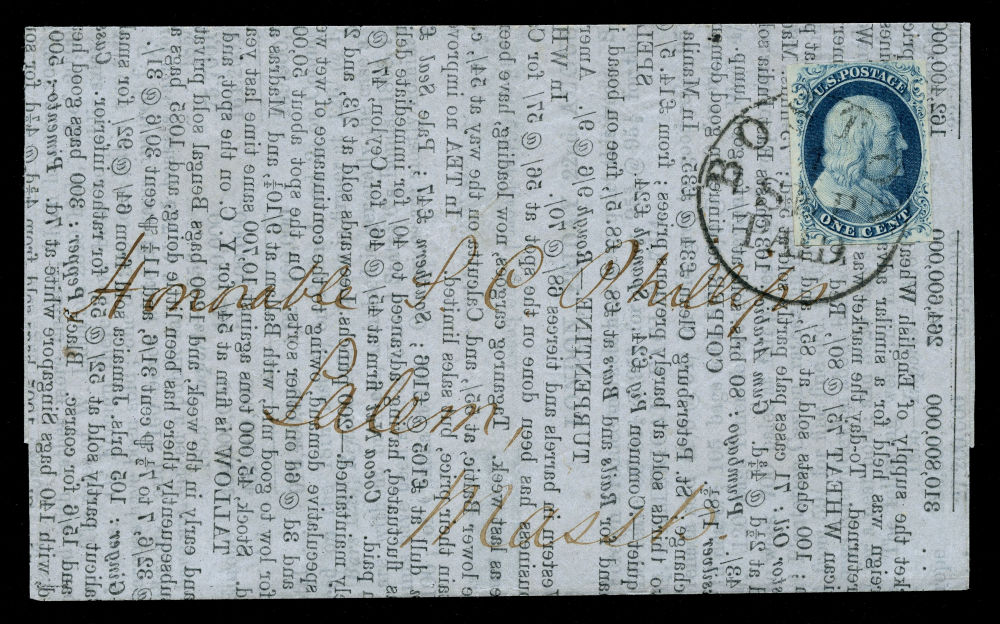
(7) 1851-57 1¢ blue Franklin Type II from Plate 2 tied by bold "Boston Paid 4 Sep." CDS on printed Prices Current sent to Salem, Massachusetts. The circular originated in London, England and is datelined "London, Friday 22nd August 1856" including printed vessel designation "PERSIA" at upper left. Carried privately across the Atlantic on the Cunard Line steamer Persia, which departed Liverpool on August 23 and arrived in New York on September 3, then entered the U.S. mails in Boston the following day. The 1¢ stamp pays the domestic circular rate. A fresh and very fine example of unauthorized private transatlantic carriage under the 1848 U.S.–Great Britain convention, mailed on arrival to avoid higher postage.
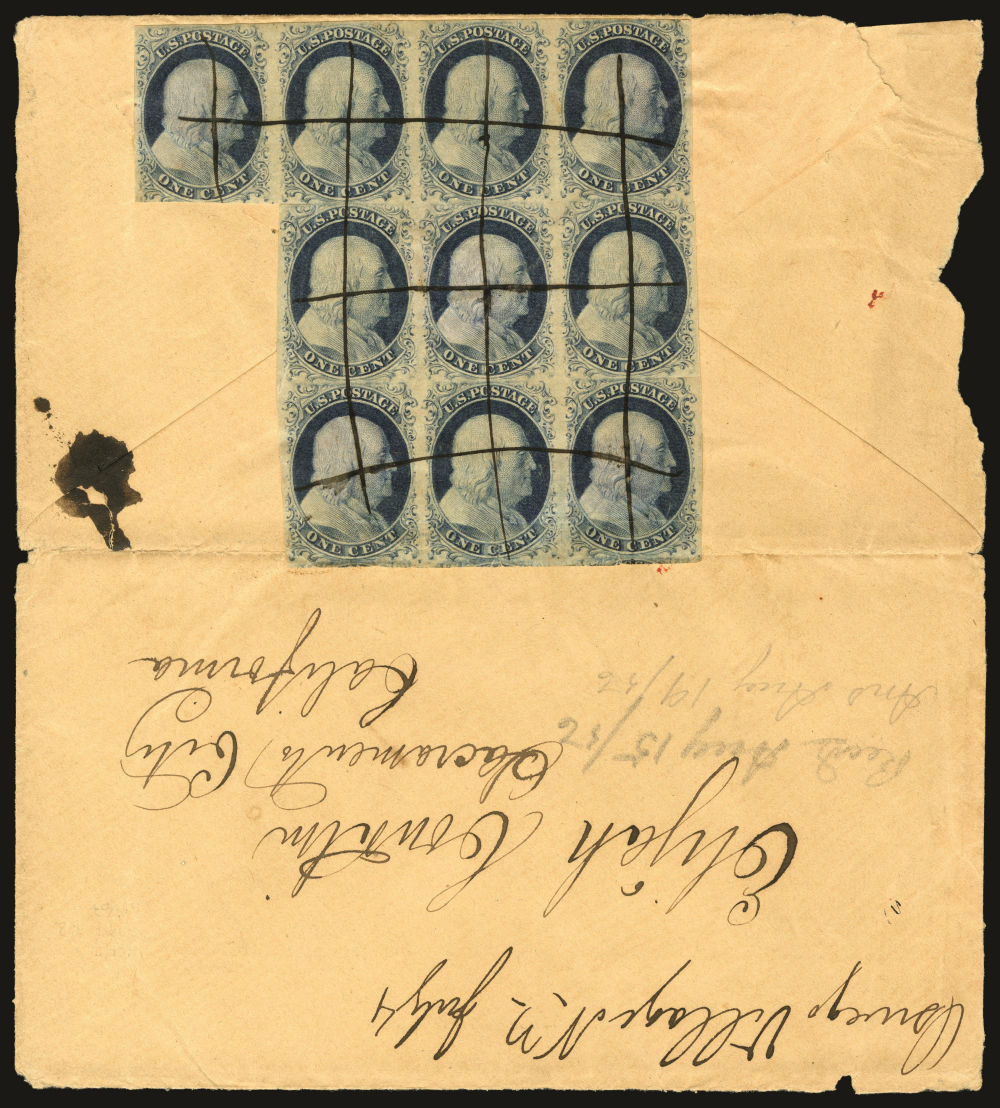
(7) 1851-57 1¢ blue Franklin Type II irregular block of ten from Plate 2, positions 44–47R2, 55–57R2, 65–67R2, used by manuscript cancels on 1856 cover from Oswego Village, New York to Sacramento, California. This remarkable franking was used to pay the 10¢ transcontinental rate via overland mail. The stamps are tied by bold pen strokes and neatly affixed across the top flap of a buff envelope addressed to Sacramento City, California. Docketed with mailing and receipt dates: July 4, 1856 (Oswego Village) and August 15, 1856 (Sacramento), indicating longer-than-expected transit. Original letter from the recipient's brother discussing business matters accompanies the cover. The bottom stamps affected by originally being folded over the crease of the cover along with cover faults from opening, though still a fine and visually impressive transcontinental cover, showcasing both an unusual franking and an extraordinary multiple of the 1¢ Franklin, mounted on exhibit page.
With 1985 APS certificate, cat. value $2,500 for two Plate 2 blocks of four and a pair off cover.
Sale No: 0925
Lot No: 57
Symbol: Cover
Cat No: 7/11A
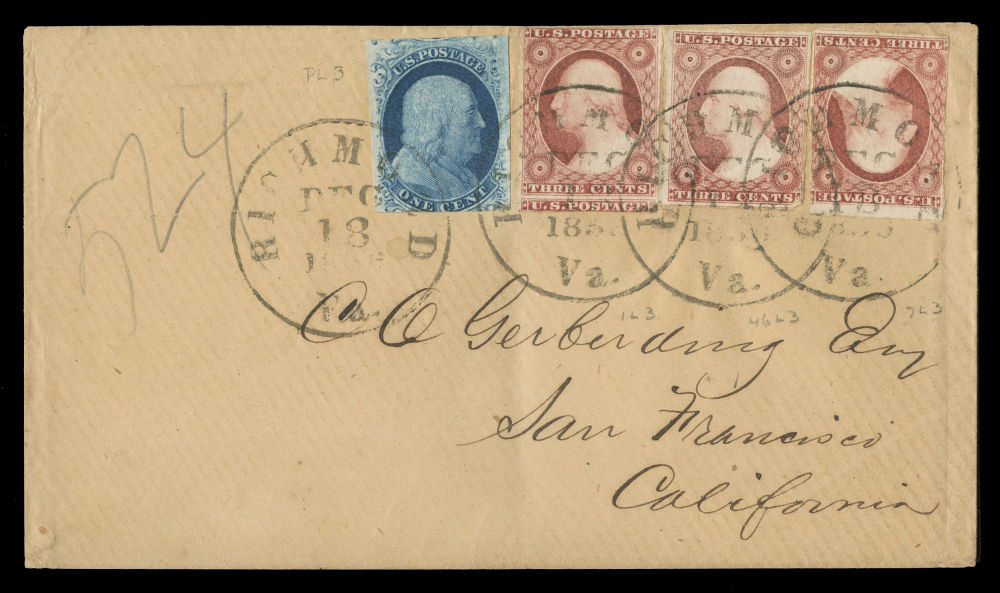
(7/11A) Three 1851-57 3¢ dull red Washington Type II singles, one with sheet margin (pos. 7L3) at top and another (pos. 1L3) including large portion of stamp below, and 1¢ blue Franklin Type II Plate 3 single tied by four strikes of bold “Richmond Va. Dec 18 1856” cds on buff cover addressed to San Francisco, large pencil “524” docketing at left. A clean and well-balanced use from Virginia to California, especially nice with the inclusion of a 1¢ Type II from Plate 3.
With 1990 Philatelic Foundation certificate, cat. value $550 for 1¢ Plate 3 used on cover.
Sale No: 0925
Lot No: 58
Symbol: Cover
Cat No: 7/11A
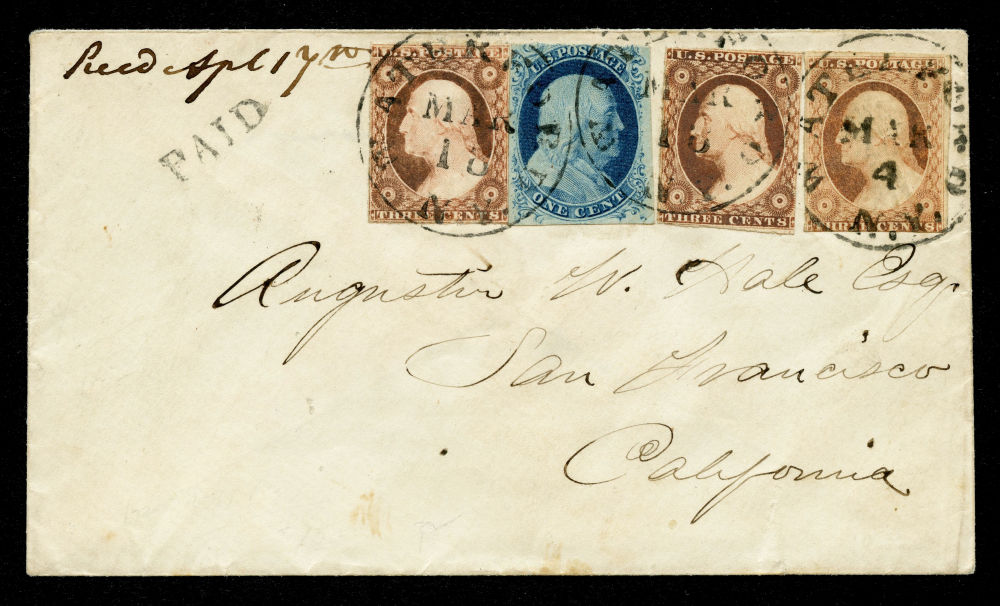
(7/11A) Horizontal franking of three 1851-57 3¢ dull red Washington Type II singles and one 1¢ blue Franklin Type II tied on cover to San Francisco paying the 10-cent transcontinental rate. Originally mailed with a single 3¢ stamp (far right) with "Waterford, NY Mar 4" cds applied, then held for insufficient postage and remailed two weeks later with a complete 10-cent rate franking. The remaining three stamps were tied by "Waterford, NY Mar 18" cds cancels. Likely after the additional stamps were added, a “PAID” handstamp was applied at upper left. Manuscript “Recd April 19th” docketing at top left, fine-v.f.
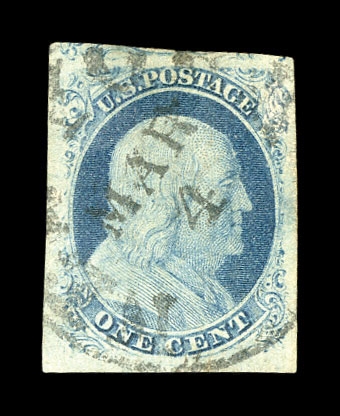
(8) 1851-57 1¢ blue Franklin Type III, position 99R2, used with March 4 town cds cancel, corner repair at top right with part of the design drawn in. Still a fine appearing example of the best position featuring the Type III characteristics, the only one on Plate 2.
With 2025 Philatelic Foundation certificate, cat. value $5,500.
(8A) 1851-57 1¢ blue Franklin Type IIIa, position 55R4, used with unobtrusive black town cds cancel, fair margins all around to just touching at bottom of right side, fine-v.f.
With 2025 Philatelic Foundation certificate, cat. value $750
(8A) 1¢ blue Franklin Type IIIa, Relief D from Plate 4 used by manuscript pen cancel, fine.
Mr. Boyd plated this stamp as 79R4 and stated "a good Type IIIa becoming a poor Type III with tiny break at bottom" - the PF declined to verify position and certified as Type IIIa, sold as such here.
With 2025 Philatelic Foundation certificate, cat. value $375.
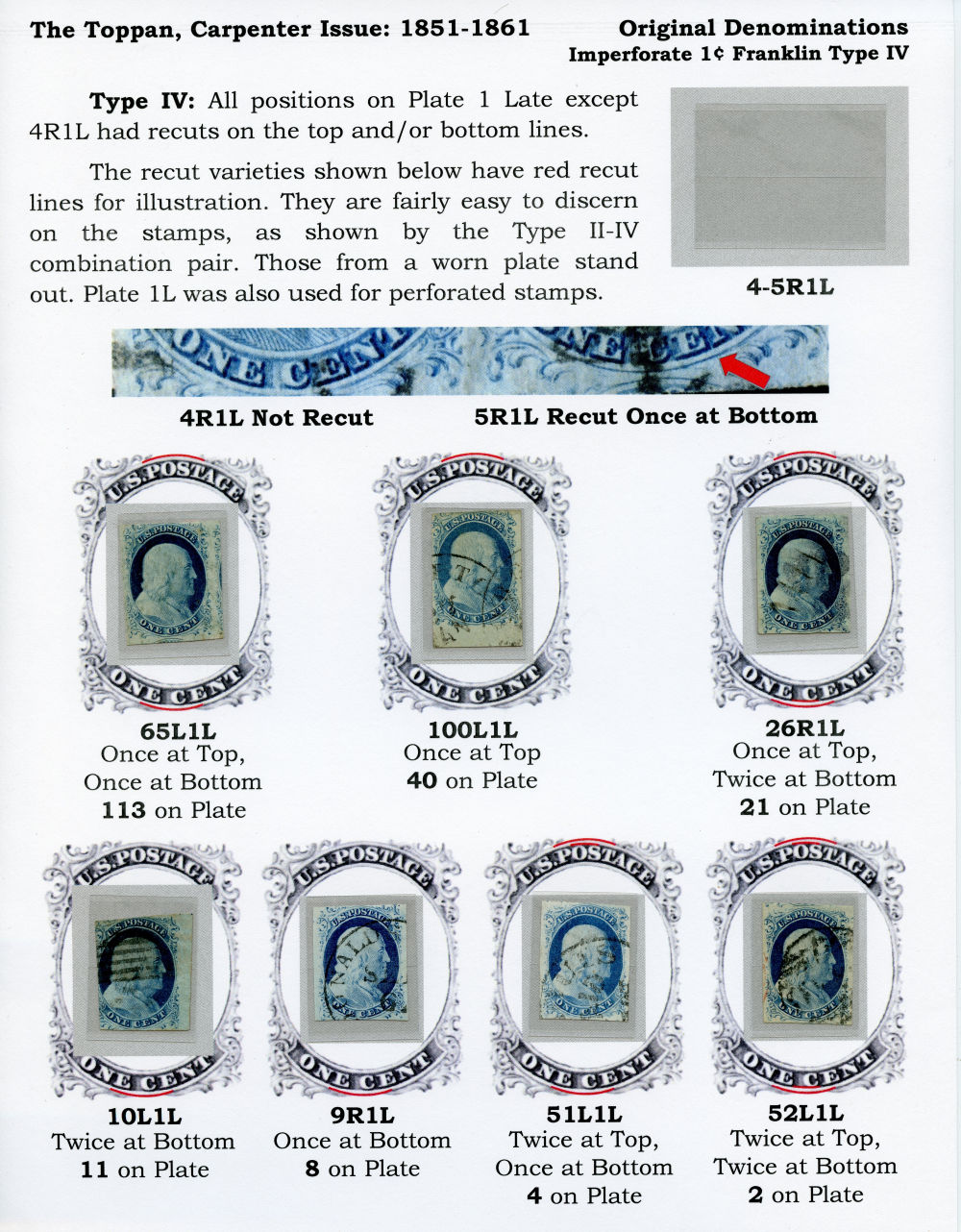
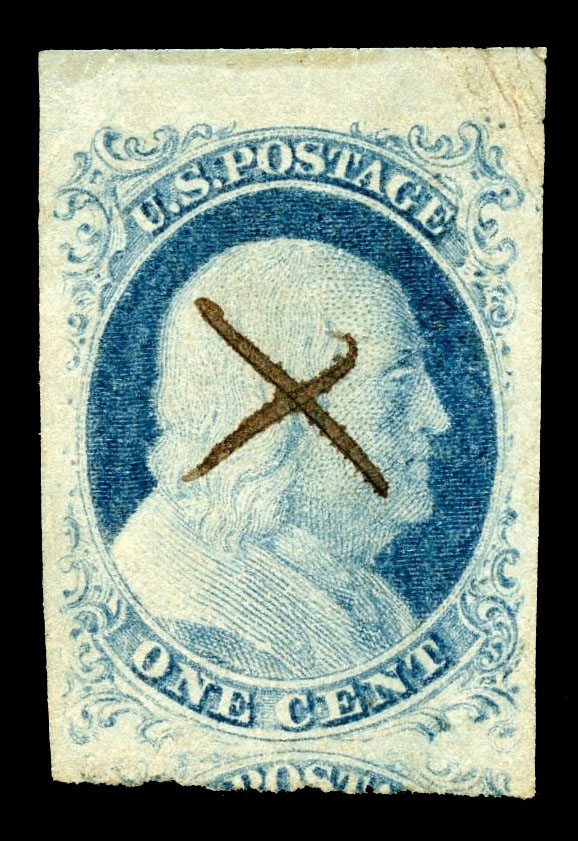
(9) 1851-57 1¢ blue Franklin Type IV used group of seven stamps representing each of the seven recut varieties listed in the Scott catalogue, all mounted on an explanatory exhibit page and each with its plate position identified. Includes: Position 65L1L, recut once at top and once at bottom (113 on Plate 1L), with light cancel and margins showing parts of adjacent stamps; Position 100L1L, recut once at top (40 on Plate 1L), with sheet margin at bottom, a prominent double transfer, black cds cancel, and 2005 PFC noting a thin spot at left; Position 26R1L, recut once at top and twice at bottom (21 on Plate 1L), pen cancel; Position 10L1L, recut twice at bottom (11 on Plate 1L), with sheet margin at right and black grid cancel; Position 9R1L, recut once at bottom (8 on Plate 1L), with black cds; Position 51L1L, recut twice at top and once at bottom (4 on Plate 1L), black cds cancel and 2025 PFC; and Position 52L1L, recut twice at top and bottom (2 on Plate 1L), bold Boston large "PAID" cancel and accompanied by 1985, 2008, and 2025 PFCs. A fine-v.f. and complete Scott-listed recut variety group, ideal for students of plating and recut studies of the 1¢ 1851 Issue.
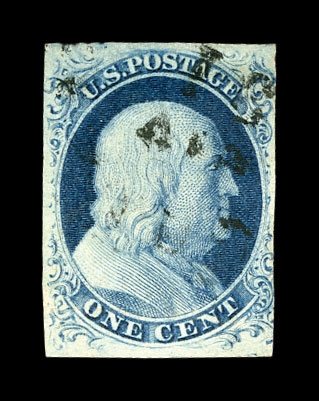
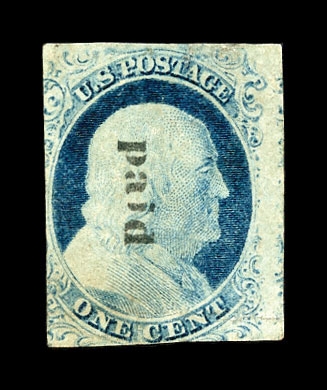
(9) 1851-57 1¢ blue Franklin Type IV used bearing a full strike of the scarce lowercase printed “paid” precancel in black, nice margins at top and right while in at left and bottom. The stamp has a small tear at top right and a horizontal crease at bottom right, though neither detracts from the overall visual appeal and boldly struck "paid" precancel.
Stanley Ashbrook in his book dedicated to the 1851-57 1¢ Issue believed these markings were likely produced from standard newspaper type and likely “the overprinting was done in a newspaper printing plant, and the stamps were used on wrappers enclosing newspapers or more than probable, on the newspapers themselves.” Even with small faults, this remains a scarce and desirable example of the printed “paid” precancel on a 1¢ Type IV stamp.
With 2014 Philatelic Foundation certificate, cat. value $2,600.
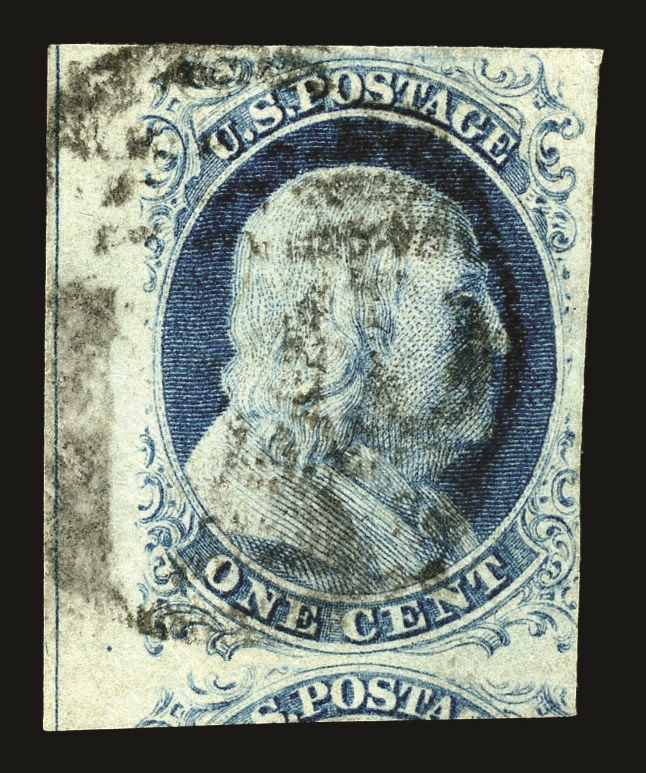
(9) Two 1851-57 1¢ blue Franklin used singles, positions 91L1L and 7R1L, each showing rare residual characteristics from Transfer Roll Zero—the earliest used roll in the production of the 1¢ 1851 issue.
Position 7R1L – Recut Once at Bottom: Features clear traces of complete bottom ornaments from Transfer Roll Zero, as seen in the circled comparison detail. These ornaments were incompletely erased when the original entry at 10-30R1 was repositioned and reversed, ultimately becoming positions 71–91L1. Single used with manuscript pen cancel, with corner crease at top left.
Position 91L1L – Recut Once at Top, Triple Transfer, One Inverted: Displays prominent traces of the inverted “ONE CENT” label, a striking visual artifact from the original die entry attempt. This position provides a key visual link to the abandoned die entry and recut process. Single used by black New York datestamp, corner crease at top right.
Position 91L1L with 2025 Philatelic Foundation certificate.
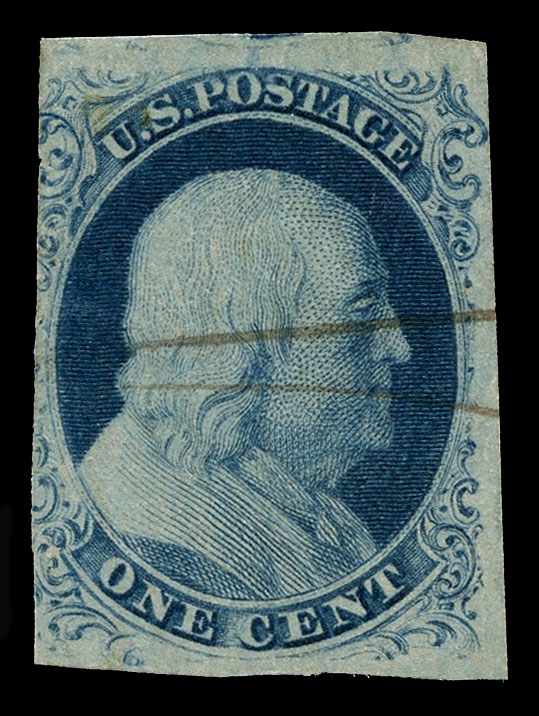
(9) 1851-57 1¢ blue Franklin, position 41R1L, used left margin single with guideline at left and margins all around including part of adjoining stamp at bottom, showing cracked plate variety with a line through the bust, one of the first to occur. A very fine positional piece for Plate 1L.
With 2002 Philatelic Foundation and 2008 PSE certificates.
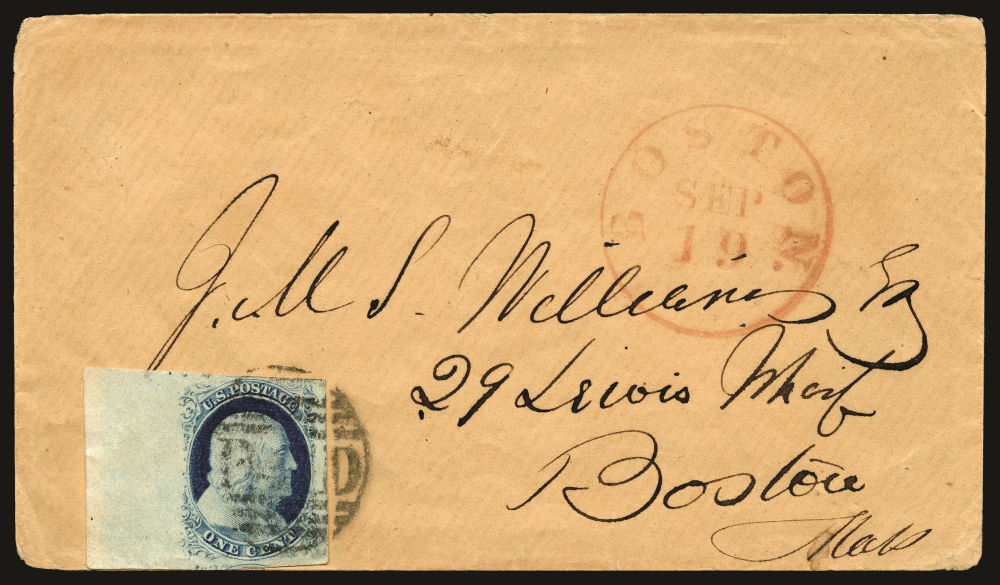
(9) 1851-57 1¢ blue Franklin Type IV, position 71L1, with triple transfer, one inverted, left sheet margin single tied by bold strike of large Boston "PAID" in grid cancel on locally addressed cover to 29 Lewis Wharf, Boston, Mass. A very fine example of one of the most dramatic and desirable transfer varieties from Plate 1L, made even more visually stunning by the presence of the stamp's large sheet margin used on a drop cover sent within Boston.
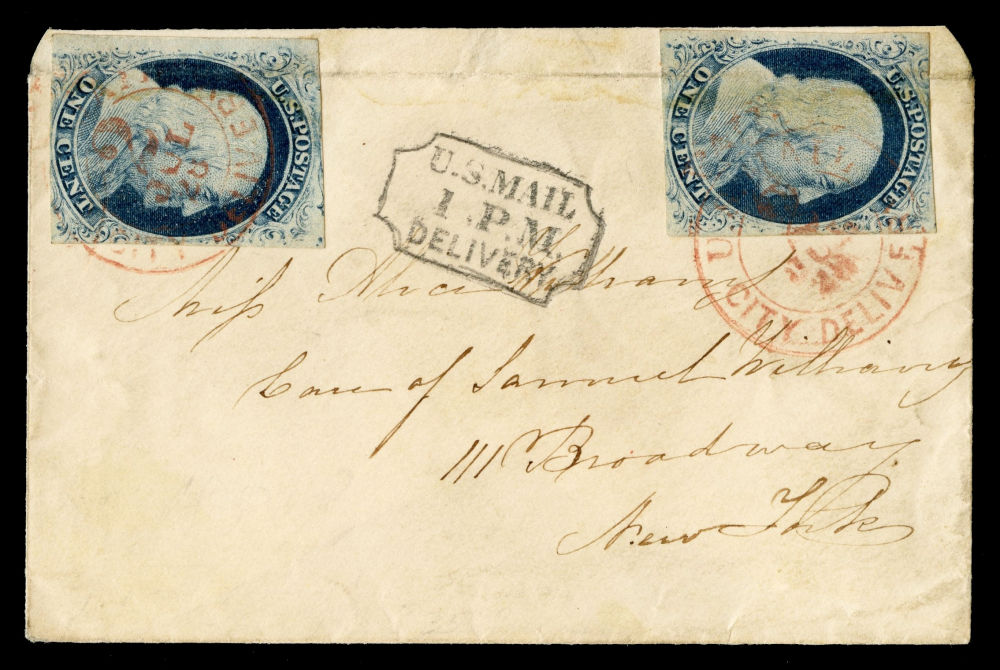
(9) Two 1851-57 1¢ blue Franklin Type IV singles tied by red "U.S. Mail City Delivery 2 Jul 28" cds cancels on locally addressed cover to 111 Broadway, New York City, with bold black "U.S. MAIL 1 P.M. DELIVERY" octagonal carrier marking at center. Stamps originally affixed overlapping the top edge, now folded down and pressed flat for display. A nice example of New York City local drop letter service, with a 1¢ Franklin paying the drop rate and an additional 1¢ Franklin paying for carrier delivery to a street address alongside both red and black New York carrier department markings. Light wear at corners, otherwise a very fine and visually striking carrier usage mounted on exhibit page.
Ex. Middledorf, cat. value $320 for two 1¢ Franklin Type IV singles with red carrrier cancels.
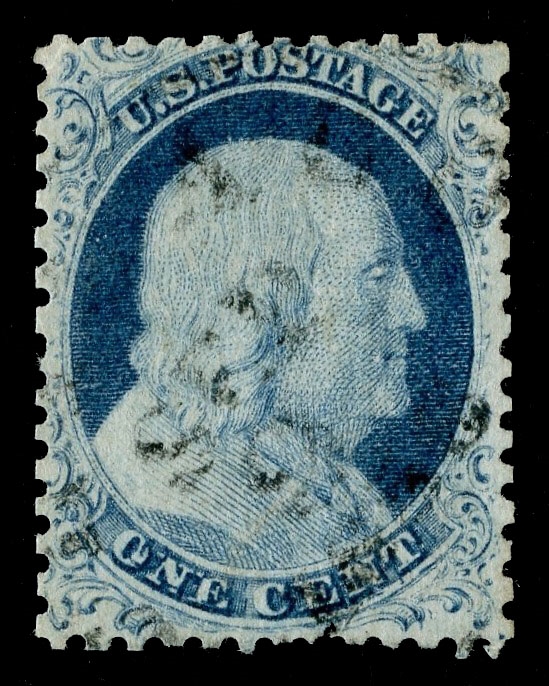
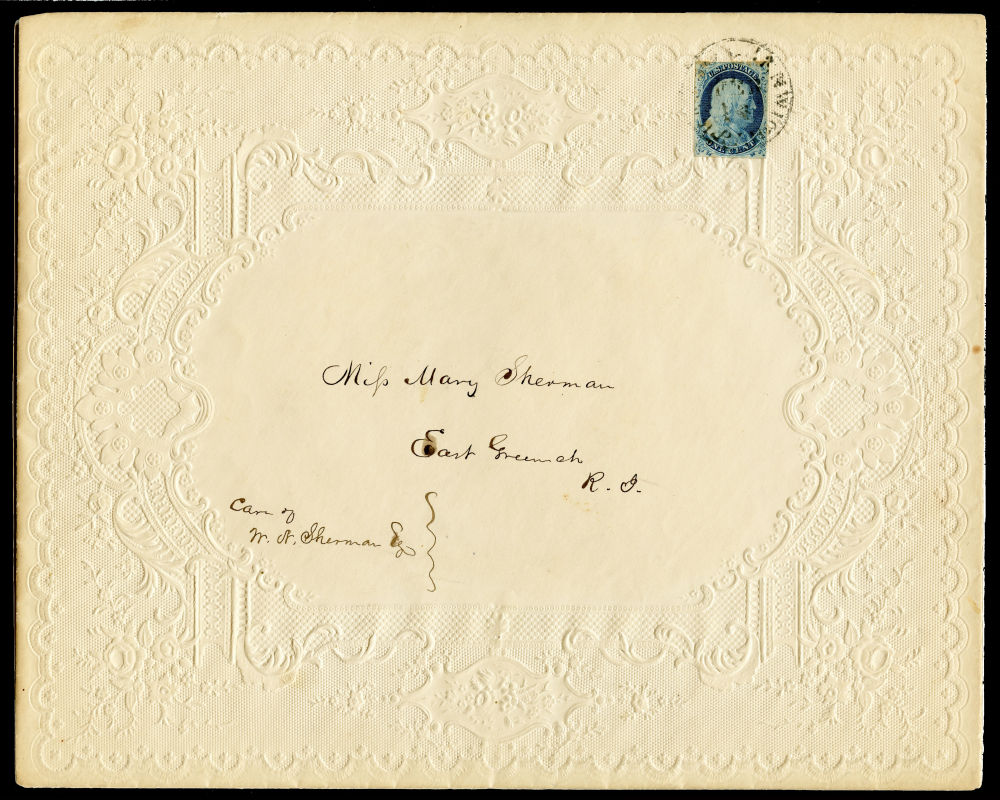
(9) 1851-57 1¢ blue Franklin Type IV tied by black "East Greenwich, R.I. Feb 14" cds on large embossed Valentine drop rate cover addressed to Miss Mary Sherman. An extraordinary example of a locally delivered drop letter, franked with the 1851 1¢ Issue stamp. The envelope measures an impressive 8¼ × 10¼ inches and is elaborately embossed with floral and scrollwork border designs, housing a lavishly decorated original enclosure. The Valentine enclosure features gold foil accents, hand-colored floral elements, and a printed central message titled “I’ll Love Thee Ever Dearly,” flanked by embossed Cupids and doves.
A beautiful and very fine example of an oversized romantic enclosure, carried as a drop letter within the same town for a penny—an exceptional value for such a grand Valentine even in the 1850s.
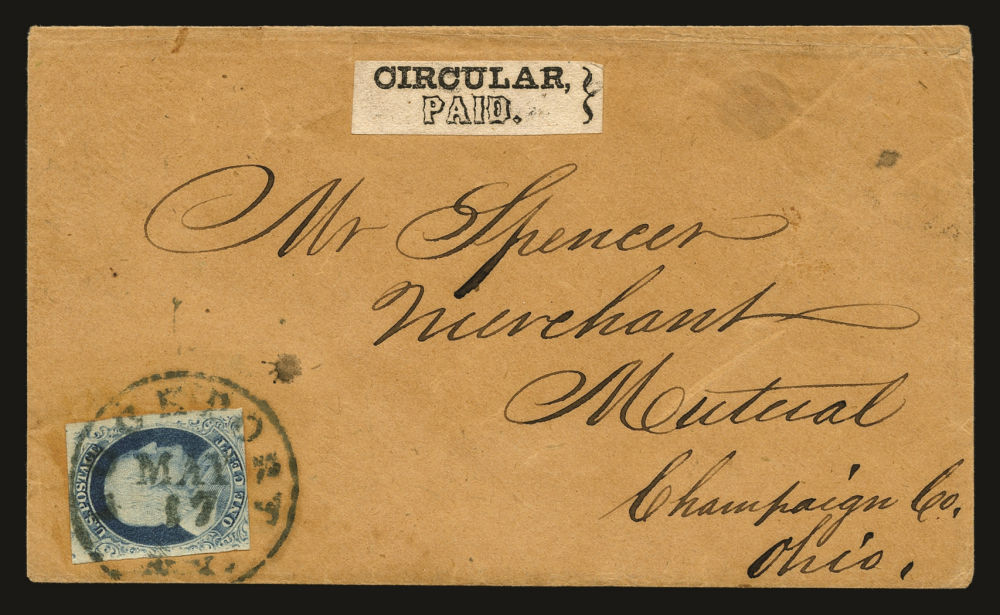
(9) 1851-57 1¢ blue Franklin Type IV tied by bold "Lockport N.Y. May 17" cds on brown circular-rate cover addressed to Mr. Spencer Merchant, Mutual, Champaign Co., Ohio featuring an affixed "Circular, Paid." black-on-white label at upper center. Enclosed is the original 1850s printed circular from George W. Merchant promoting his "celebrated gargling oil." The circular promotes the product’s distribution through country merchants and druggists, marking the early days of national medicinal marketing.
Very Fine and appealing, this example combines classic circular-rate postal history with the roots of a business that would later issue its own Private Die Proprietary stamps in the 1860s (see Scott RS178–RS179).